

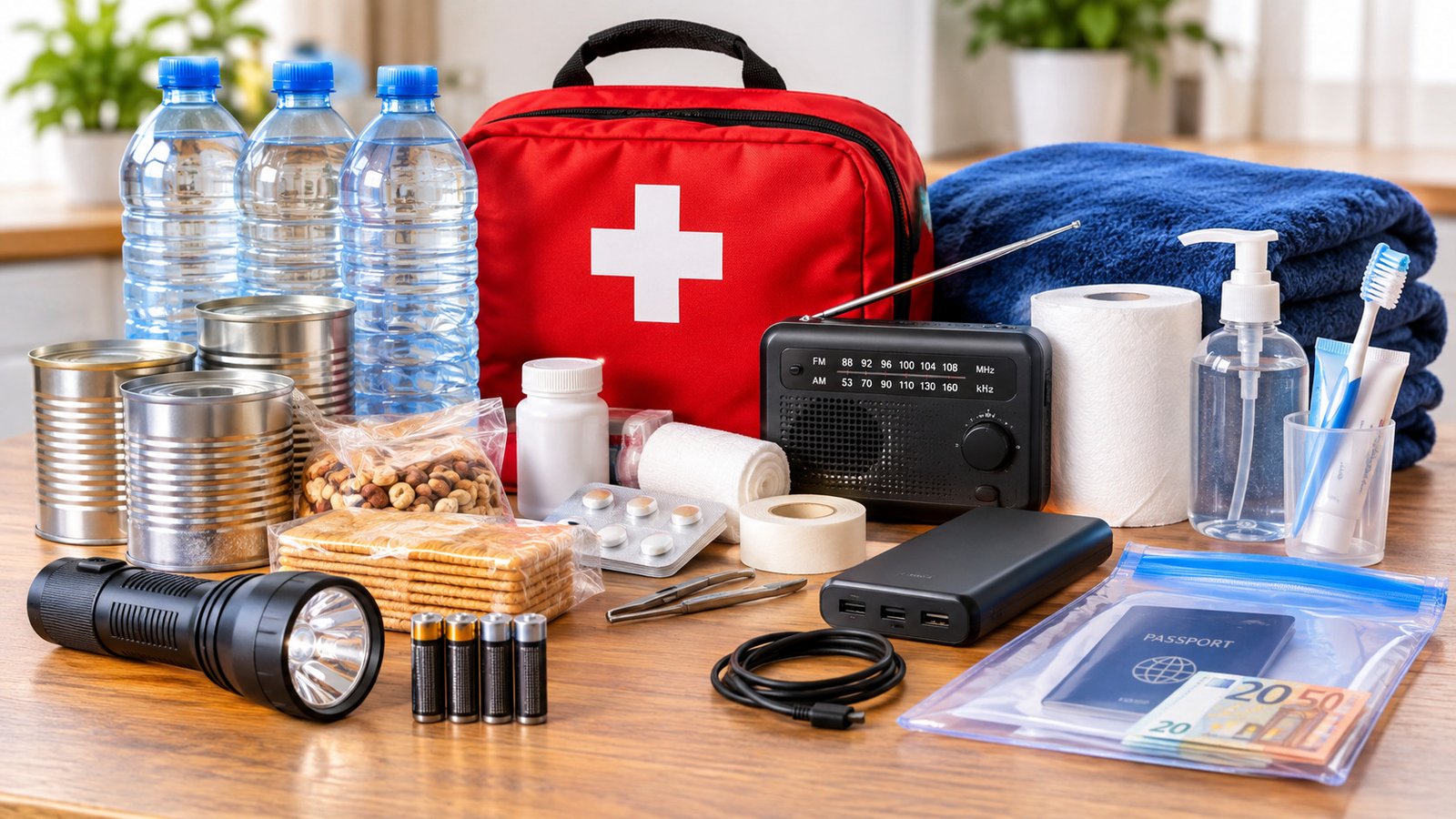
The European Commission now recommends that households keep an emergency kit at home that lets them get by on their own for at least 72 hours. The guidelines were published on November 3, 2026, as the European Civil Protection Forum opened in Brussels, and they’re not binding. But picture this: you’re at home on an ordinary day, and suddenly the power goes out. At first it looks like just another outage, the kind that comes back in a few minutes or a couple of hours. But after a few minutes, things that don’t usually happen in a power outage start to happen.
That’s how it went on April 28, 2025, when a blackout hit Portugal and Spain. I realized it wasn’t a normal outage when, after I called my husband to let him know, he said some people were saying the same thing was happening in Spain, and we live in Portugal. A few minutes after I hung up, my cell phone had no signal anymore. At that moment I felt something very similar to what I felt at the start of the COVID pandemic: the fear of uncertainty, of not knowing how long it would last.
I put together what the European Commission and FEMA’s Ready.gov recommend, did the math for a family of four and shared, along the way, what I learned that day when we weren’t prepared at all.
Why an emergency kit is built for 72 hours
There’s a reason behind the 72 hours. Right after a major crisis, there aren’t enough resources to meet every need at once, and it can take a while for help to reach everyone. That’s why the Commission treats 72 hours as a minimum for the most critical period, so emergency services can focus first on the people who need them most.
The Build a Kit page on Ready.gov follows the same logic: being prepared means having your own food, water and other supplies to last for several days. In other words, this applies whether you live in Europe or in the US. And a blackout is the scenario that best shows why it matters, because without power one thing leads to another.
What happens at home when the power goes out
From what I lived through, the problems don’t arrive all at once. They show up one after another, and each one calls for a different item in the kit.
First, the cell signal disappears
When the power went out, my phone still had signal, and I managed to reach my husband, as I mentioned at the start. A little while later, the signal was gone too. I had no internet and no news at all about what was happening, with no idea what had caused the blackout or whether anything was being done to fix it.
That’s why a battery-powered radio is an essential item. Ready.gov puts a battery-powered or hand crank radio on its basic kit list, along with a flashlight and extra batteries, and the European Commission also lists a battery-powered radio to receive emergency information when power and networks fail. The Paraná Civil Defense in Brazil (in Portuguese) adds a tip that makes a difference: store the batteries separately from the radio, so they don’t drain or leak inside it.

Then the tap water stops
This was the part that surprised me most. Until that day, I didn’t know that without power we also lose water at the tap. In many apartment buildings, water only makes it up the pipes because of electric pumps, and with no pump there’s no water.
Luckily, my husband came home soon and went to get water from a fountain that was safe to drink. There he found a line of people in the same situation as us. If the power goes out and the water is still running, take the chance to fill bottles and pots before it stops.
For the kit, Ready.gov recommends one gallon of water per person per day, for drinking and sanitation. For a family of four over three days, that’s 12 gallons (about 45 liters). The European Commission points out that stored water is also for basic cooking, so if you have the space, keep a little extra.
Food that doesn’t need a stove
The European recommendation is to store food that can be eaten without cooking, because in a blackout the electric stove, the microwave and even the igniter may not work. Canned goods, crackers, dried fruit and nuts work well. The full list by category, with what lasts longest in the cupboard, is in the article on non-perishable foods.

Cash and a full tank
Another thing I learned: we had very little cash, and in a situation like that, without power, there’s no way to use a card. Ready.gov includes cash in its kit, and today I understand exactly why.
The gas stations also had huge lines. Luckily our tank was full and we didn’t have to wait. That’s why it’s worth not letting the car run low on gas.
Emergency kit list for a family of four
Based on the European Commission and the Ready.gov list, this is a starting point for four people over three days:
| Item | How much for 4 people | Why it’s there |
|---|---|---|
| Drinking water | 12 gallons, about 45 liters (1 gallon per person per day) | Drinking and basic hygiene |
| Ready-to-eat food | Meals for 3 days | No stove, microwave or fridge |
| Battery-powered radio and extra batteries | 1 radio | Official information without internet |
| Flashlight and batteries | 1 per household member | Light without the fire risk |
| First aid kit and prescription medications | For 3 days, with copies of prescriptions | The pharmacy may be closed |
| Copies of documents | In a waterproof container | Protected from water and close at hand |
| Cash | Small bills | Cards don’t work without power |
| Charged power bank | 1 or 2 | Use your phone when the signal comes back |
| Manual can opener and whistle | 1 of each | Open cans and signal for help |
The kit should be adapted to each household, as the European Commission points out, taking into account children, older adults and people with an illness or disability. With a small child at home, add diapers, formula and a toy to keep them busy, and if you have a pet, food and extra water for it too, as Ready.gov recommends.
How to build the kit without panic and without spending it all at once
You don’t have to buy everything in the same week. The easiest path is to add one or two items to each monthly grocery run, like a case of water one time and the radio the next, until the kit is complete. Keep everything together, somewhere easy to find in the dark, and make sure the whole family knows where it is.
And since food and water expire, check the dates every so often and use up what expires first, as I explain in the article on the FIFO pantry. That way the kit rotates along with your regular groceries and nothing gets lost in the back of the cupboard.

When the power goes out: what to do in the first few hours
If a blackout happens, the kit already helps a lot, but a few steps in the first hours also make a difference:
- Reach your family while you still have signal. Agree on where everyone will be, because your phone may stop working at any moment, as happened to me.
- Turn on the radio. That’s how official instructions will reach you.
- Fill containers if there’s still water. The building’s pump may stop and the water may run out soon after.
- Save your phone battery. Put it in airplane mode and use the power bank only when you need it.
- Choose flashlights over candles. If you use a candle, never leave it lit near curtains or out of sight, especially with kids at home.
A preparation you make hoping you’ll never need it
Thankfully, in our case the power came back quickly, because we weren’t at all prepared to last many days. That’s exactly what an emergency kit is for: so that, if it happens, your family has water, food, information and cash to get through the first three days more calmly. Start today with a battery-powered radio and a case of water.
This content is for informational purposes only and does not replace guidance from FEMA or your local emergency management agency.