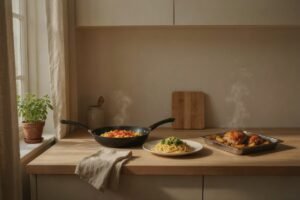


You know that night when you open the cupboard to make dinner and find out the rice is gone, the beans are almost out and the grocery store is already closed? Or that week of heavy rain when nobody wants to leave the house? That’s when you’re grateful to have some non-perishable foods stored away, because they hold the fort without needing a fridge.
Non-perishable foods are the ones that take a long time to spoil at room temperature, like rice, beans, lentils, flours, pasta, canned goods, oil, sugar, salt, coffee and powdered milk. They’re kept in the cupboard, in a dry, clean and well-ventilated spot, and they still have an expiration date. Below you’ll find the complete list by category, the right way to store them and an emergency kit for the family.
If your pantry is still a mess, it’s worth starting with the step-by-step guide on how to organize your pantry. Here the focus is on what goes inside it.
What are non-perishable foods (and why they last so long)
The booklet “Cuidados com os alimentos” (Food Care) (in Portuguese), from Brazil’s Ministry of Health, defines non-perishable foods as those that only deteriorate at room temperature after a relatively long time, and gives grains, canned goods, flours, pasta and legumes as examples. In my part of Brazil, we call this group of foods “o grosso”, roughly “the staples”. Perishable foods, like meat, eggs, milk and dairy, spoil quickly outside the fridge.
The secret is water. The drier the food, the less room microorganisms have to grow, which is why dry beans last for months in the cupboard while cooked beans need the fridge the same day. Canned goods and shelf-stable cartons follow a different logic, because they go through a sterilization process and stay sealed with no contact with air.
But non-perishable doesn’t mean forever. The Ministry of Health itself points out that expiration dates must be checked carefully and that the closer a product is to its date, the sooner it should be used. In other words, storing isn’t enough: your supply needs to rotate, and that’s what makes the difference down the road.
Non-perishable foods list by category
With that in mind, building the list gets easier. I split it by category, because that’s how we look for things in the cupboard and in the grocery aisle too:
| Category | Examples | What they’re for |
|---|---|---|
| Grains and legumes | Rice, beans, lentils, chickpeas, dried split peas, popcorn kernels | The base of lunch and dinner |
| Flours and pasta | Wheat flour, cassava flour, cornmeal, oats, tapioca starch, pasta | Cakes, corn couscous, porridge, quick pasta dishes |
| Canned and jarred goods | Sardines, tuna, corn, peas, whole peeled tomatoes, tomato paste | Ready protein and vegetables for busy nights |
| Milk and drinks | Powdered milk, shelf-stable milk, coffee, tea | Breakfast covered |
| Cooking basics | Vegetable oil, olive oil, salt, sugar, vinegar | Seasoning and cooking everything above |
| Snacks and extras | Saltine crackers, nuts, dried fruit, chocolate drink mix | Kids’ snacks and school lunches |
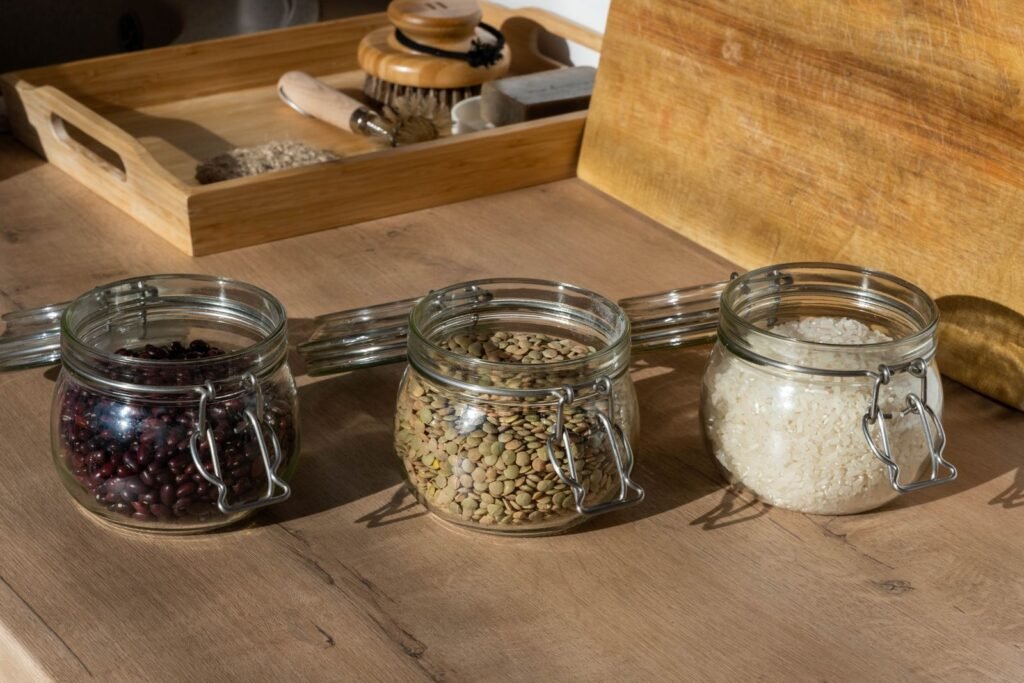
Notice that almost everything on the list ends up on the everyday plate. That’s why I wouldn’t stock the pantry with food the family doesn’t eat just because it lasts a long time, since the risk is the package expiring, forgotten at the back of the cupboard.
Which non-perishable foods are best for your health
Here’s a tip almost nobody gives. The Dietary Guidelines for the Brazilian Population (in Portuguese) group foods by how processed they are: unprocessed or minimally processed foods (rice, beans, lentils, flours, powdered milk) should be the base; processed foods, like canned goods, come in with care, ideally choosing labels with less salt and sugar; and ultra-processed foods, like instant noodles, powdered soup and cake mix, should be avoided.
In practice, your supply is healthier when most of it is grains, flours and legumes, with canned goods as backup. The Guidelines also teach a handy trick for the supermarket shelf: if the ingredient list is long (five items or more) and has names you wouldn’t use in your own kitchen, like hydrogenated vegetable fat, fructose syrup or flavoring, it’s probably ultra-processed.
How to build a non-perishable pantry without blowing your budget
Now that you know what goes in, the question is how much to buy. The Ministry of Health says non-perishable foods can be stocked and bought in larger amounts at a time, but warns that the quantity depends on how much space you have in your pantry. So there’s no need to fill the cart all at once.
The easiest path, in my view, is to use your monthly shopping trip and add one or two extra items each time, like an extra bag of rice or two cans of sardines. After a few trips your supply is built, without a big expense in a single month. And if you already plan the week’s meals, like in the cheap weekly meal plan, it’s easy to see what the household really eats.
When choosing, take a careful look at the packaging, because the Ministry of Health advises against buying products with bulging, rusty, dented or torn packaging, or with an unusual color, smell or texture. Check the expiration date too and, if there are two batches on the shelf, take the one with the later date.
How to store non-perishable foods so they last until their date
You’ve done the shopping and you’re home, now what? The same Ministry of Health booklet says the storage area should be well-ventilated, clean and free of moisture, with an ideal temperature of 25 °C (77 °F). In hot climates, like much of Brazil in summer, that’s a challenge, so it’s worth avoiding cupboards above the stove, next to the fridge (which gives off heat at the back) or in the afternoon sun.
- Cleaning products go in a different cupboard, never on the same shelf as food.
- Opened packages go into a tightly sealed container, which keeps out moisture and little pests like weevils.
- When you switch containers, write the expiration date on the jar with a label or masking tape, or the information ends up in the trash with the bag.
- Products that expire first go in front, and the ones you just bought go in the back.
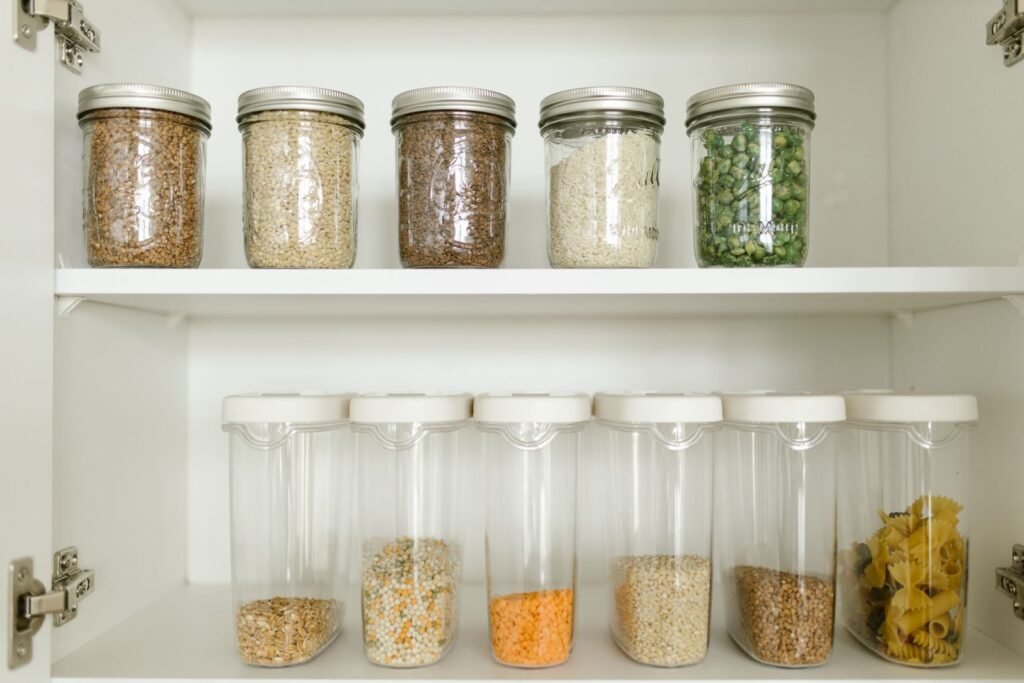
That last tip may seem silly, but it’s the one that prevents the most waste, because we always grab whatever is closest. If the new packages go in front, the old ones stay hidden and expire without anyone noticing.
Non-perishable foods for emergencies: the family kit
So far we’ve talked about the everyday pantry, but there’s a second use for these foods: a reserve for when things get out of control, like a flood, a power outage that lasts days, a water shortage or an illness that puts everyone in bed. The family emergency plan from the São Paulo State Civil Defense (in Portuguese) recommends storing drinking water and non-perishable food for three days, along with clothes, medicine and supplies for pets.
Water is usually the forgotten item, and it’s the most important one. The Paraná State Civil Defense (in Portuguese) calculates 2 liters (about half a gallon) per person per day, which comes to 30 liters (about 8 gallons) for a family of five to get through three days. The same list includes a manual can opener, because there’s no point having sardines if you can’t open them, and supplies for babies, like diapers.
Reading from outside Brazil? The US site Ready.gov advises storing at least one gallon of water per person per day for several days, for drinking and sanitation, which is roughly twice the 2 liters from Paraná above (the figure this guide uses). Its emergency food page also suggests canned foods you can eat as they are, a manual can opener, and foods your family will actually eat.
When choosing food for the kit, I’d go for things you can eat without a stove, since in an emergency you may run out of gas, power or water for cooking, and round it out with a few staples that become a meal whenever you can cook. A suggested starting point:
| Item | Why it’s in the kit |
|---|---|
| Drinking water | 2 liters per person per day, according to the Paraná State Civil Defense |
| Canned sardines and tuna | Ready-to-eat protein |
| Canned corn and peas | Vegetables that don’t need cooking |
| Saltine crackers | A bread substitute that kids like |
| Shelf-stable and powdered milk | Breakfast and snacks |
| Nuts and dried fruit | Energy in a small space |
| Rice | A universal carb that goes with almost anything |
| Pasta | Another carb, for variety |
| Wheat flour | Works in lots of different recipes |
| Vegetable oil | For cooking all of the above |
| Salt | The basic seasoning for any meal |
| Manual can opener | Without it, the cans are useless |
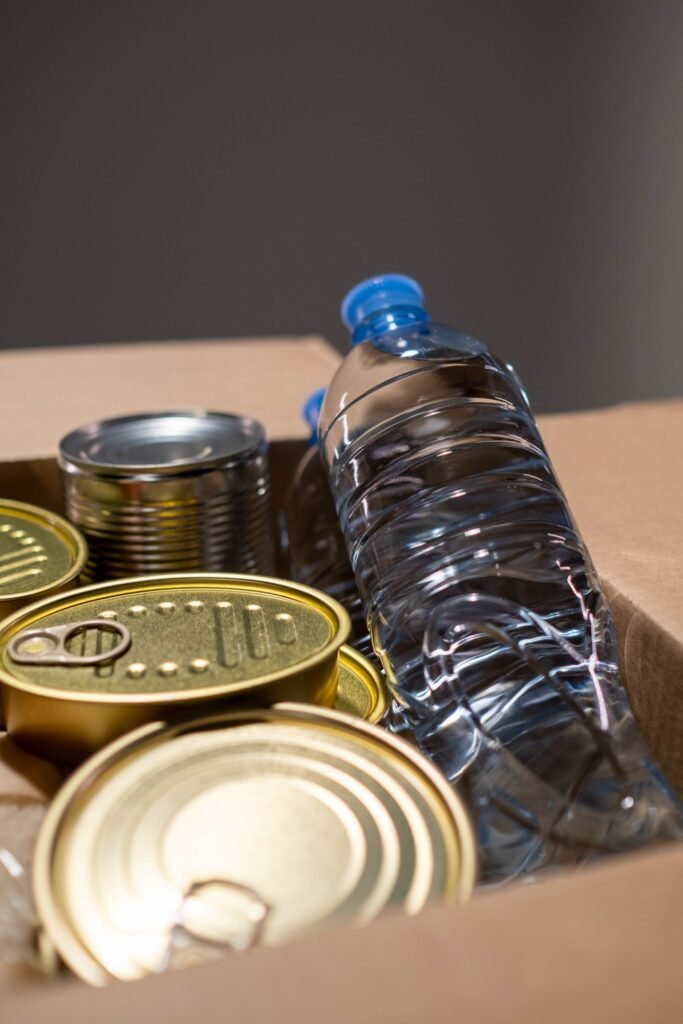
If your tap water is treated and you usually filter it at home, it’s worth reading the guide on whether you can drink tap water in Brazil, because in an emergency, stored bottled water is the simplest guarantee.
In real life: keeping the supply going with kids and little time
Putting the kit together is the easy part; the hard part is remembering it six months later. The São Paulo State Civil Defense recommends checking every six months that nothing has expired, and I’d set a phone reminder for two dates that are easy to remember, like the start of the school year and the start of the year-end holidays.
With kids at home, there’s one more detail: the crackers in the kit disappear fast if they’re in the same cupboard as the snacks. That’s why the emergency supply works better in a separate, closed box, ideally somewhere high up, and whatever is about to expire goes into the week’s menu first.
One idea that helps is a monthly “pantry night”, when dinner comes only from what’s stored, like rice with sardines and corn or a pea soup. That way the supply rotates effortlessly, and the kids even enjoy picking the can of the day. Then just replace what you used on your next shopping trip.
Still have questions?
Can you eat non-perishable food after the expiration date?
I don’t recommend it. The expiration date is the period the manufacturer guarantees for that product, and the Ministry of Health advises using whatever is closest to expiring first precisely so you don’t reach that point.
Are eggs non-perishable?
No. The Ministry of Health lists eggs among perishable foods, along with meat, milk and dairy, so they don’t go in the emergency kit.
Is shelf-stable carton milk non-perishable?
Unopened, yes, because the shelf-stable packaging doesn’t need refrigeration. Once opened, it goes in the fridge like any other milk.
Which non-perishable foods should you donate to food drives?
It’s best to ask the organization what it needs at the moment. In general, rice, beans, pasta, oil and canned goods are welcome, always within the expiration date and with intact packaging.
Are canned foods bad for your health?
According to the Dietary Guidelines, canned and jarred foods are processed foods and can be part of your diet in small amounts. When shopping, choose lower-sodium versions, as the Guidelines advise for processed foods.
To wrap up
Non-perishable foods are the base of a practical pantry and an emergency kit, as long as they’re foods your family actually eats and the supply rotates before it expires. Start with grains, flours and a few cans, store them in a cool, dry place and check the dates every six months.
Informational content based on guidance from Brazilian health and civil defense agencies. It does not replace advice from a dietitian or doctor.