

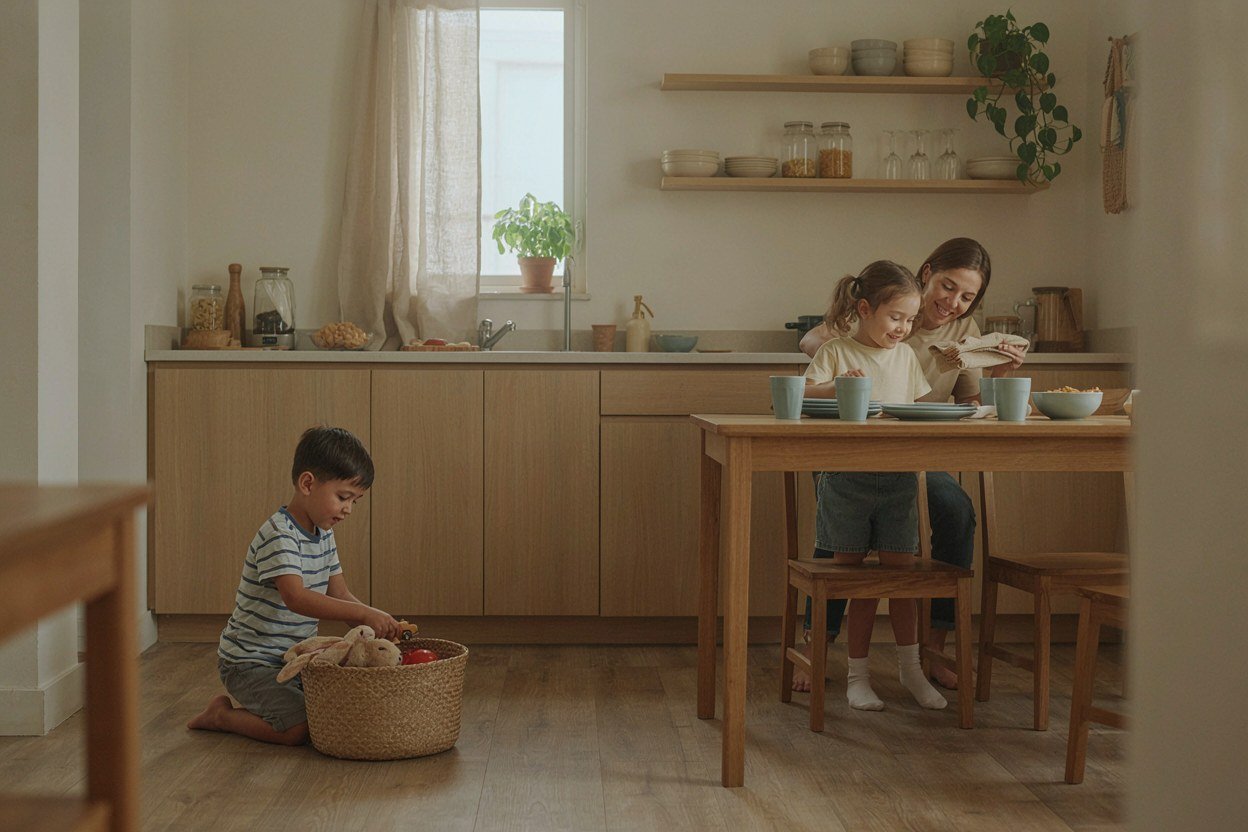
It’s one of those days. You left work, picked up the kids at your mom’s, sat in traffic all the way home, and the second you walk in they kick their shoes off along the hallway and head straight for the TV. It irritates you deeply, because you’ve explained a thousand times where everything goes, and it feels pointless. Maybe your evening has other details, but anyone with kids knows the feeling of being the only one who does everything.
If you’re here, you’ve decided to change that, and you’re looking for chores for kids by age so you know what your child can really do and don’t end up being unfair by asking for something they can’t manage yet. First of all, congratulations! Teaching chores isn’t only about helping around the house or helping mom. It also trains your kids for adult life, when they’ll have to do many things for themselves.
This guide is built from the lists of the American Academy of Pediatrics (AAP) and the American Academy of Child and Adolescent Psychiatry (AACAP). I separated what a child does alone from what still needs an adult nearby, and added the kitchen and household-product safety tips from the AAP and the national Poison Help line.
Why it’s worth sharing the house with the little ones
Doing everything yourself seems faster, and at first it is. But the AACAP reminds us that a chore is a skill, and skills take time to learn. If you have to circle back to help finish, it means the child is still learning, not that they have no knack for it.
And the effort pays off. According to the same academy, research suggests benefits to including chores in a child’s routine as early as age 3, because children who do chores may show higher self-esteem, more responsibility and better tools for dealing with frustration. In other words, shoes in the right place are just the part you can see.
There’s a practical side too: every chore that truly moves into a child’s hands gives a piece of your evening back to you. And our goal here is to show you how to live better.
Chores for kids by age: what each stage can handle
The chart below combines the suggestions of both academies. The right-hand column shows what usually needs an adult nearby, either because something hot or breakable is involved or because the child is still learning the steps.
| Age | Does it alone (once taught) | With an adult nearby |
|---|---|---|
| 2 to 3 years | Putting toys and light groceries away | Getting dressed |
| 4 to 5 years | Making their own bed (their way) and helping clear the table after dinner | Filling the pet’s food bowl |
| 6 to 7 years | Setting and clearing the table, wiping the table, sweeping, putting clean clothes away, taking dirty clothes to the hamper and watering plants | Washing plastic dishes at the sink and packing a lunch |
| 8 to 9 years | Vacuuming, putting groceries away, making their own snack and loading or unloading the dishwasher | Helping make dinner |
| 10 to 12 years | Changing bed sheets, cleaning the kitchen and bathroom, washing and folding laundry | Cooking a simple meal and watching a younger sibling with an adult at home |
Notice the list keeps adding up: what came in at age 4 still counts at age 8. And it’s a starting point, not a ruler. The AAP notes that each child brings their own temperament to a chore: some drift off in the middle, others have trouble getting organized or leaving a game, and that counts in what you expect from each one.

With kids of different ages, it helps to make a chore chart. It helps split things up without a fight, and the same chore can have two versions: the older one sets out plates and silverware, and the little one brings the napkins. No perfectionism, please: if the fork ends up on the wrong side, life goes on.
Chores can fit into the child’s routine and keep evolving. When something becomes easy and no longer needs reminding, you add one the child still has to learn. For kids who can’t read yet, chores can go on the wall with drawings instead of words. I explained how to set it up in the article on the chore chart for kids.
How to teach a new chore without having to redo it
Knowing what each age can handle is half the way. The other half is teaching in a way that the chore really leaves your plate, and the two academies give concrete clues:
- One new chore at a time. The AAP advises that, for a child who had no responsibilities at home before, chores come in one at a time, because a long list is overwhelming.
- Say exactly what to do. “Help me out here” teaches nothing. The AACAP suggests clear requests, like “please take out the trash from the kitchen after breakfast.”
- Do it together the first few times. A child learns by watching someone at home do it, and with the little ones it’s worth turning a longer chore into a game, with music or a race against the clock.
- Tie the chore to a moment that already exists, like “after breakfast” or “before bath.” The AAP recommends doing chores at the same time every day, because that way the child remembers without you having to ask.
- Praise the effort, not the result. If the towel is folded crooked, leave it crooked. A child who watches an adult redo everything learns fast that trying is pointless. That’s why I insist: no perfectionism.

Chores with many steps take patience. Nobody is born knowing how to fold a fitted sheet (plenty of adults don’t know either), so do it with your child until you see they understand the whole path, without getting mixed up about what the next step is. Only then do they do it alone, and you keep an eye on it.
There will be days when they get stuck. Wait to see if they sort it out on their own, and wait for them to ask you for help. Sometimes we get in the way of a child’s process with too many interventions. The real problem is when they start complaining and saying they won’t do it! So what do you do?
Let’s go. First of all, when you set the chores, agree in advance on the consequence of not doing them. It shouldn’t be something said only in the heat of a scolding: the AAP suggests losing a privilege and reminds us that screen time is a privilege, not a right. For example: “the table has to be set before dinner is ready; if it isn’t, no tablet tomorrow.” Just don’t let a refusal pass with no consequence at all.
These chores keep the house from turning into a war zone every day, which makes it possible to have a 30-minute routine to keep the house tidy and clean even with kids.
What still isn’t a child’s chore: the safety limits
Some things don’t depend on maturity, they depend on risk. Before handing a chore over, look at these three points.
Cleaning products. The AAP’s kitchen safety guidance says to store strong cleaners, dishwasher soap and other dangerous products in a high cabinet, locked and out of sight, and never to transfer them into containers that look as if they might hold food. It also warns that detergent packets or pods pose a special risk for young children, who may mistake them for candy. In practice, if you need a product during cleaning, you’re the one who pours it, and you choose a mild one that won’t irritate the skin. When an older child cleans the bathroom, you set out the product, read the label with them and put it back up high when they finish.
If an accident happens, call Poison Help at 1-800-222-1222, a free and confidential line run by the poison centers, and call 911 in an emergency.
The stove and hot things. The same AAP guidance says to always turn pot handles toward the back of the stove so a child can’t reach up and grab them, to know where your child is whenever you walk with hot liquid like coffee, soup or boiling water, and never to carry your child at the same time. That’s also why, in the chart, helping with dinner stays in the adult column through age 12.
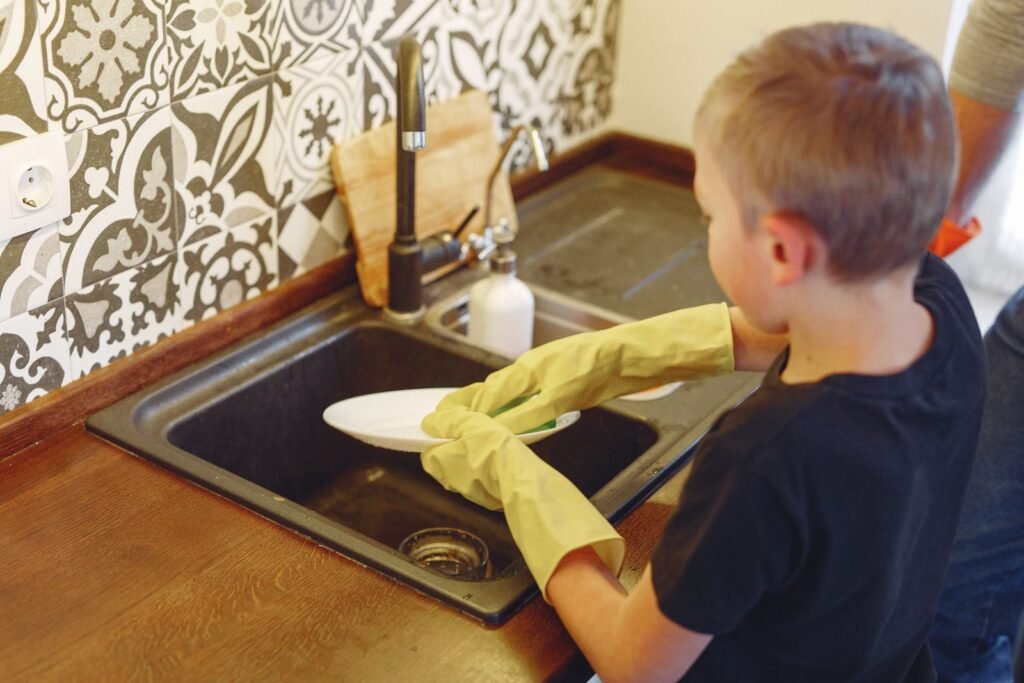
Glass and knives. The AAP list starts dishes with plastic ones, at ages 5 to 7. Glass cups, knives and heavy pots can wait until the child’s hands are steadier, and until then they stay with you.
Common questions about age-appropriate chores
Can a 2 or 3-year-old already have a chore?
Yes, as long as it’s short and done together with you, like putting toys away in the basket. At that age the chore is more company than help, and that’s fine: the habit starts there.
What if my child can’t do the chore for their age?
Go back one age band on the chores for kids by age chart and try to understand why, sometimes it’s just a lack of skill. If the difficulty goes on for a long time and shows up at school too, the AAP advises talking to your pediatrician.
With school, homework and activities, is there still time for chores?
The AAP considers it a mistake to leave a child with no duties at home because they’re too busy. What changes is the size: on full days, one short chore between homework and bath keeps the habit going.
Where to start today
Pick one chore from the chart for each child, agree on when it happens at tonight’s dinner and do it together the first few times. Once it’s running on its own, the second one comes in.
This content is informational and was organized from the sources of pediatric societies and poison-control services. It does not replace the guidance of the pediatrician who looks after your family, especially if your child has specific developmental needs.