

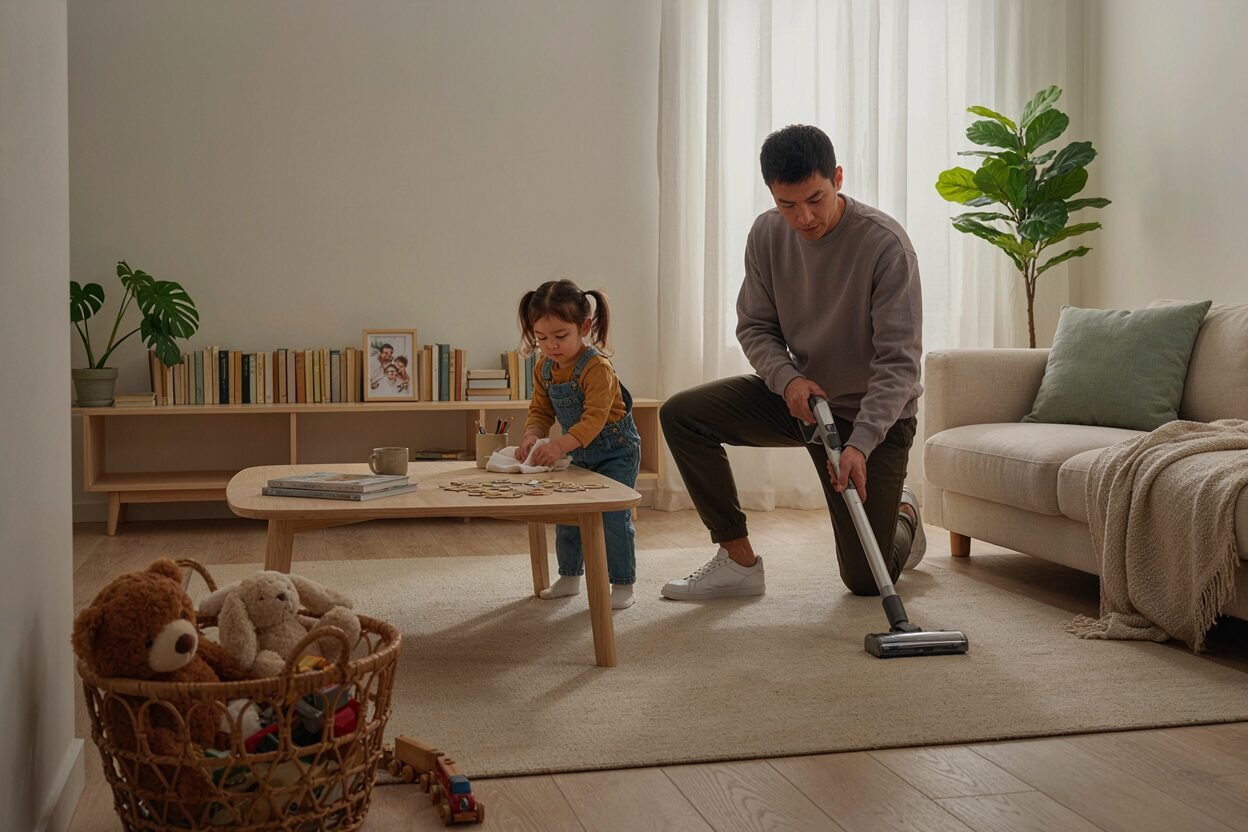
Picture this: you spent the whole Saturday cleaning, the house was spotless, and by Tuesday there are sneakers in the middle of the living room, dishes in the sink and a Lego piece waiting for your bare foot. Anyone with kids knows this cycle well, and the worst part is not even the tiredness, it is the feeling that all that effort vanished in two days.
The good news is that keeping an organized and clean house with young kids depends less on big cleaning days and more on a short system that repeats every day. Split upkeep into three 10-minute blocks (one in the morning, one task of the day and a reset at night), give a fixed spot to the things that spread around the most and get the kids involved from early on.
Why the house gets messy again (even after a deep clean)
A deep clean cleans everything at once, but family life does not stop after it, and every meal, game or trip home from school moves something out of place. If nothing puts those things back every day, the mess keeps piling up until the next deep clean.
But there is a silent enemy of tidying up: things without a set place cannot be put away. Picture that piece of furniture covered in stuff: every time you clean, you dust it and “organize” those random things, which only keep multiplying. Take a good look at them: are they really necessary? If they are, find a proper place for them.
Finally, I think it is important to talk about splitting the chores among everyone in the house. Without fighting, talk it over with your partner and your kids. Hand out the tasks and keep an eye on how everyone is doing while they learn to pitch in. According to the IBGE household survey (PNAD Contínua) (in Portuguese), in 2022 women in Brazil spent an average of 21.3 hours a week on housework and caring for others, against 11.7 hours for men. It does not have to be that way in your family.
So the goal here is a house organized and clean enough for the family to run and for you to sit on the couch at night and get the rest you have been looking for at the end of a tiring day.
A 30-minute routine for an organized and clean house: the three blocks
The whole routine fits in 30 minutes because it does not try to clean the entire house every day. It gets the house ready in the morning, handles one cleaning spot per day and puts everything back in place at night. And before you ask: cooking and laundry are not part of this count, because they already have their own time. The 30 minutes are only for upkeep.
| Block | When | Time | What it solves |
|---|---|---|---|
| Morning | Right after breakfast | 10 min | Bedrooms and kitchen ready for the day |
| Task of the day | Whenever it fits | 10 min | One cleaning spot, on rotation |
| Night reset | After dinner | 10 min | Everything back in place and the kitchen cleared |
Morning block (10 minutes)
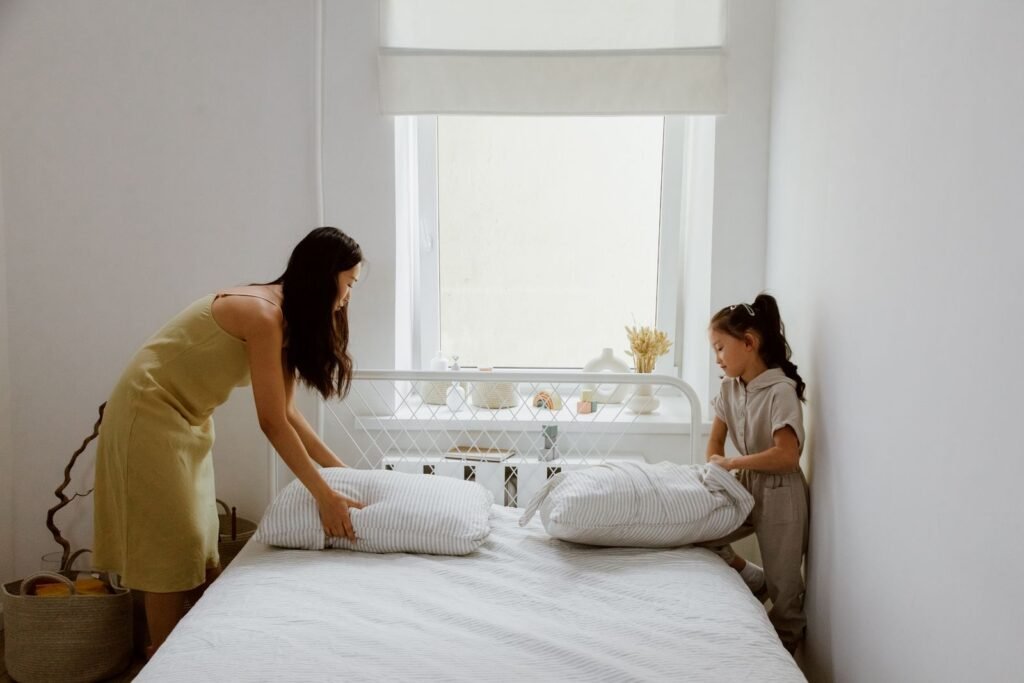
Everyone makes their own bed as soon as they get up (a bed made by a child, their way, counts), the windows stay open while everyone gets ready and pajamas go into the drawer or the laundry basket.
After breakfast, the dishes go straight into the sink or the dishwasher and the counter stays clear, because a clean counter in the morning is halfway to dinner.
Task of the day (10 minutes)
Instead of cleaning the bathroom, living room and fridge on the same Saturday, each day gets just one spot, and 10 focused minutes are enough because, done every week, the dirt has no time to build up.
If you work outside the home, do these tasks as soon as you get back. Do not sit on the couch first, thinking you will rest for a bit and do it later, because that is how you end up skipping what you were supposed to do that day. It is really important that, for at least 2 months, you make an effort to keep these habits until they become automatic.
| Day | 10-minute task |
|---|---|
| Monday | Bathroom: sink, toilet and mirror |
| Tuesday | Dust the furniture in the living room and bedrooms |
| Wednesday | Sweep or vacuum the floor in the main walkways |
| Thursday | Fridge: toss what has expired and wipe one shelf |
| Friday | Change the bed linen or towels and put them in the wash |
| Saturday | Kitchen focus (tip: use this day to cook for the whole week) |
| Sunday | Plan the week: tasks, appointments, uniforms and backpacks |
Saturday is a great day to make the rest of your week easier: do just 20 minutes of upkeep, only in the morning and at night. The suggestion is to use this day to cook the week’s meals, so that on the other days the meals only need reheating. If deciding the menu is still a struggle, the cheap weekly meal plan has a ready-made template with a shopping list.
On Sunday, you can look at what worked during the week and what could be better, and plan ahead to make the week calmer. On Thursday, while the fridge is open, take a look at the pantry cupboard too, and if it also needs some order, the 5 steps to organize your pantry can sort it out.
Night reset (10 minutes)
The reset is the block that makes the biggest difference, because it stops one day’s mess from becoming the week’s mess. It has two 5-minute parts, ideally with a timer or upbeat music, since kids are far more willing to race the clock than to hear “go tidy your room”.
In the first 5 minutes, a basket goes around the rooms collecting what is out of place, and each person takes what is theirs: toys go back in the box, shoes go on the shoe rack and backpacks on the hook, with the next day’s clothes already set aside. In the other 5, someone closes the kitchen, with an empty sink, the counter and stove wiped and the trash taken out if it is full. This only fits in 5 minutes if the dinner dishes are no longer in the sink, and here is a tip that avoids a lot of arguments: get a dishwasher! Seriously, it really helps.
Where to start: the first five weeks
That is why I suggest adding one block per week, starting with the one that shows the most visible results.
- Week 1, getting the house ready. This first week is key for these tips to really work, so do it before anything else. Pick one room per day this first week and clear out all the trash, clutter, old, torn, broken and ugly things that take up space and have nowhere to be stored. For what truly matters and is useful, set a permanent place. Get the kids involved so they do the same with their toys.
- Week 2, only the night reset. This is the block you feel the very next morning, when you wake up and the house is in order. If something still had no place after the prep week, use this time to fill the gaps that show up on the floor the most: a toy box or basket in every room where the child plays, low hooks for backpacks by the door and a laundry basket in each bedroom.
- Week 3, add the morning block. With the night sorted out, the morning gets short, because the kitchen already starts the day cleared and only needs to handle breakfast.
- Week 4, add the task of the day. Since the house is already tidy, the 10 minutes become real cleaning instead of tidying.
- Week 5, time to adjust. Notice which block the family gets stuck on and change the time or the task, because the system has to fit your home, not your home fit the system.
And you do not need a full deep clean before you start: if the house is very behind, start with the prep anyway and leave the heavy cleaning for when the routine is already running.
How to keep the house organized with kids of different ages
So far the routine may sound like a grown-up thing, but an organized and clean house with kids only lasts if they are part of it. The American Academy of Pediatrics recommends age-appropriate chores, done at the same time every day so the child remembers on their own, without expecting perfection or criticizing the result.
What each child can do in the blocks
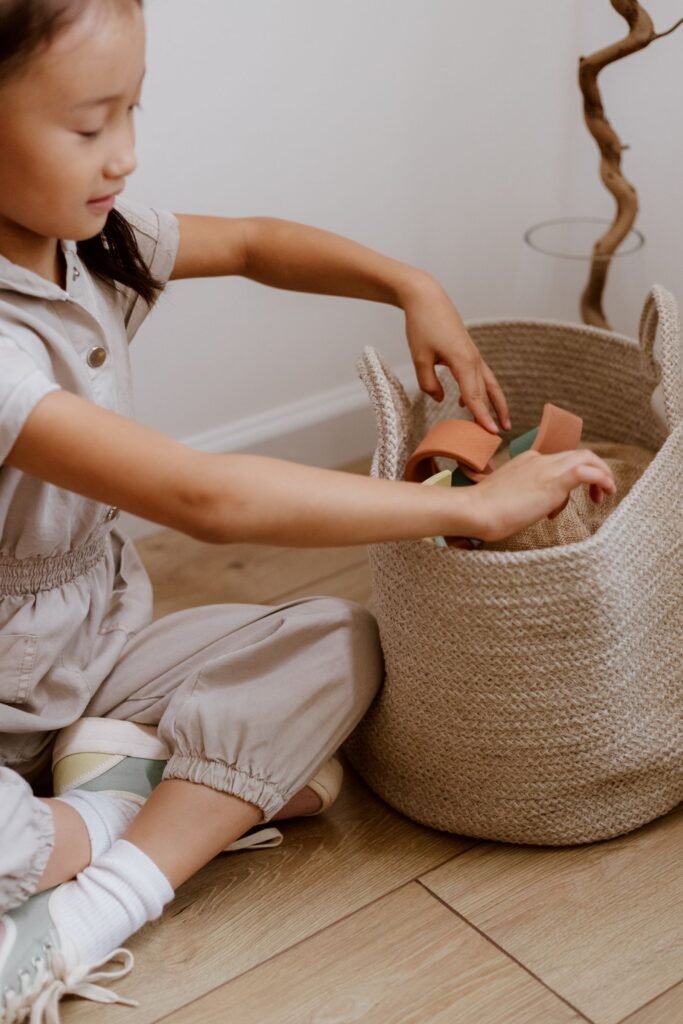
- Up to about 3 years old: put toys in the basket together with an adult and carry their own dirty clothes to the laundry basket. It is more play than chore, and that is fine.
- From 4 to 6: make their own bed, take their plate to the sink after meals and be in charge of the basket that goes around the house during the reset.
- From 7 up: how about wiping the table after dinner, putting away their own clean clothes and helping close the kitchen?
For kids who cannot read yet, a chore chart on the fridge door, with drawings instead of words, helps them know what is theirs without you having to repeat it.
How to split it between the adults
When both adults work outside the home, the simplest way is for each one to own a whole block, instead of “helping” with the other’s block. The block owner should not need reminders, but be patient in the first weeks: it may take a while for this new routine to be fully absorbed by everyone at home.

The day when nothing goes right: the 10-minute version
A child with a fever, a meeting that ran late, rain on the way to school: some days the routine just does not happen. On those days, do only the reset, with 5 minutes of basket and 5 of kitchen, and forget the rest without guilt. It makes sure tomorrow you start from zero, not from below zero.
How to keep the results after the second month
Around the seventh or eighth week, the routine usually becomes automatic, and that is when the two problems that most often bring organization systems down show up: the amount of stuff grows and the family’s routine changes.
For the amount of stuff, a one-in, one-out rule helps: a new birthday toy arrives, an older one goes into the donation box kept in a corner of the closet.
And if the routine falls apart for a whole week, which happens to everyone, do not try to restart all three blocks at once: go back to just the reset and add the others gradually, like the first time.
Over time, what changes the most is the weekend, which stops being cleaning day and goes back to being family time. And if part of that time can be yours, the self-care habits that fit a busy life offer some ideas on how to use it.
Still have questions?
How often do I need to do a heavy clean?
With the task of the day up to date, heavy cleaning (windows, tiles, behind furniture, curtains) is usually enough every two weeks or once a month, depending on the size of the house and whether you have pets. You can split it into pieces, one per week, instead of doing everything in a single day.
What if my partner does not pitch in?
Show them the blocks table at a calm moment, not in front of a full sink, and ask them to choose a whole block to own. Talking with the routine on paper usually works better than chasing them task by task.
Can I follow the 30 minutes with a baby at home?
In the first months, probably not, and there is no point in being hard on yourself about it. Stick to the 10-minute version and bring back the task of the day when the baby’s sleep starts to settle.
To wrap up
An organized and clean house with kids comes from daily upkeep, not deep cleaning: 10 minutes in the morning, one task per day and a reset at night, with everything in its place and the kids taking part. Start with the house prep week and then add one block per week.
Informational content. It does not replace professional advice.