


Saturday morning, the plan was to rest. But the sink is full, the bathroom needs rescuing and the pile of clean laundry on the bedroom chair is about to have a birthday. I don’t know if this has happened to you, but it has to me, many times. Anyone who looks after a home and kids knows the weekend, instead of rest, is when we work the most to keep the house barely livable. And there’s always that rushed cleaning we think will take a morning but swallows the whole weekend.
A weekly cleaning schedule fixes that by spreading the work across all seven days: a little every day, one room in focus at a time and laundry with its own day to wash, fold and put away. Here you’ll see how to build yours and find a ready template from Monday to Sunday, with time estimates and what the kids can do, to print from this page and stick on the fridge.
The times in the template are estimates I put together for a family of four, not measurements, so adjust them to the size of your home. The kids’ chores, on the other hand, follow the age-by-age table I published on the blog, built from the American Academy of Pediatrics (AAP) and the American Academy of Child and Adolescent Psychiatry (AACAP).
Cleaning a house takes more than a mop and a broom
Most cleaning schedules talk about sweeping, dusting and scrubbing the bathroom. But what weighs most on the week usually stays off the list: the laundry, which doesn’t end when it leaves the machine, because it still has to dry, get folded and go back into the closet. The pile on the chair exists precisely because of that; it’s the step nobody put on the calendar.
And there’s the part nobody sees, which is managing the home: deciding the menu, making the grocery list, putting away what came from the store, paying bills, checking the school calendar. That also takes time and headspace, and when it isn’t in the plan, it gets squeezed into the hours that were meant for rest.

That’s why the template in this article handles all three together, cleaning, laundry and home management, within one ceiling: up to 2 hours a day, adding up everyone’s time at home. If a day goes over that often, it’s a sign that too many tasks are piled on it or too few people are helping.
How to build yours in 4 steps
Before copying any template, do this quick exercise, because it’s what adapts the schedule to your home and not to someone else’s.
- List everything the house asks for, room by room, without forgetting laundry, groceries and bills. On paper, the real size of the job is much clearer than in your head.
- Sort by frequency: what’s daily (dishes, counters, beds, picking up what’s been left around), what’s weekly (bathroom, floors, bed linens) and what can be monthly (windows, oven, inside the cabinets).
- Give each day a single focus. One room a day and laundry split into two stages, one day to wash and another to fold and put away, keep two heavy tasks from landing together.
- Write down who does what. A schedule with no names beside it becomes mom’s to-do list, and then it loses its point.
The daily base, the one that holds the house together between one focus and the next, fits in about 30 minutes. I explained how to split those minutes into three blocks in the article on the 30-minute routine for an organized and clean house with kids; here it becomes a fixed line in the schedule.

The weekly cleaning schedule, Monday to Sunday
The cleaning schedule template below puts the four steps together. Each day’s time includes the 30-minute daily base, and Friday is for home management, when you can plan the weekly meal plan and the grocery list before Saturday’s shopping.
| Day and focus | What to do | Time | Kids can help |
|---|---|---|---|
| Every day (base) | Dishes, counters and stove, beds, picking up toys and stray objects, trash | 30 min | Put away toys (ages 2 to 3) and make their own bed (4 to 5) |
| Monday (kitchen) | Change bed linens and towels and start the wash. Stove, counters, microwave and floor | 1 hr 30 min | Take towels to the hamper (6 to 7) and help clear the table (4 to 5) |
| Tuesday (bathrooms) | Fold and put away bed linens and towels. Toilet, sink, shower, mirror and floor | 1 hr 30 min | Put away clean clothes (6 to 7) and clean the bathroom sink (10 to 12) |
| Wednesday (living room) | Wash everyday clothes. Dust, vacuum or sweep and mop | 1 hr 30 min | Sweep (6 to 7) and vacuum (8 to 9) |
| Thursday (bedrooms) | Fold and put away the week’s clothes. Dust, floors and nightstands | 1 hr 30 min | Put away their own clothes (6 to 7) and fold clothes (10 to 12) |
| Friday (home management) | Menu, grocery list, bills and calendar. Fridge: toss what has expired and clean one shelf | 1 hr | Suggest dinner ideas for the menu |
| Saturday (shopping and monthly task) | Grocery shopping and putting everything away. Laundry area and one monthly task in rotation: windows, oven, cabinets or washing machine | 2 hr | Put away light groceries (2 to 3) or all of them (8 to 9) |
| Sunday (rest) | Just the base: dishes and setting out Monday’s clothes and backpack | 30 min | Take dirty clothes to the hamper (6 to 7) |
Adding it all up gives about 9 and a half hours a week, split among the family, and no day goes over 2 hours. Notice that the laundry is never left sitting: what’s washed on Monday is put away on Tuesday, and what’s washed on Wednesday is put away on Thursday.
To print it, use your browser’s print option on this page or copy the table onto paper.
Who does what, without it all landing on you
According to the U.S. Bureau of Labor Statistics, on an average day in 2025, 87 percent of women and 75 percent of men spent some time on household activities such as housework, cooking, lawn care or household management. On the days they did, women averaged 2.8 hours and men 2.1 hours. A printed family cleaning schedule helps change that math, because the split is visible to everyone. A simple way is for each adult to take whole days: for example, one handles kitchen and laundry, and the other bathrooms, shopping and bills.
Kids join in little by little, with what their age allows. The full list, with what each stage can do alone and what still needs an adult nearby, is in the article on chores for kids by age; in the template, I only put the ones that match each day’s focus.
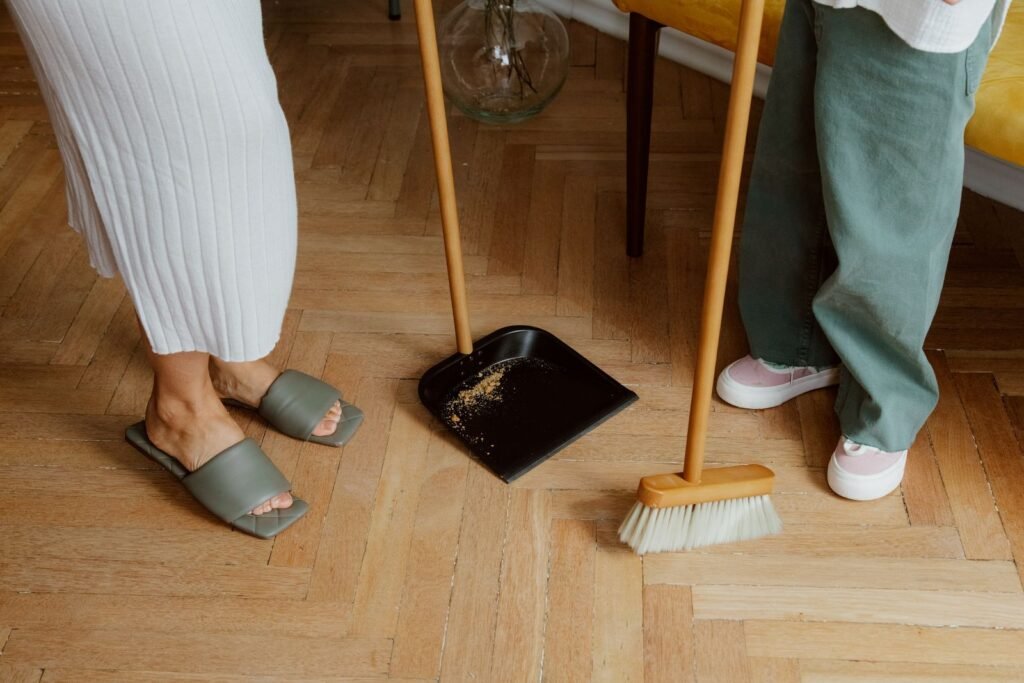
At first, the T-shirt will come out folded crooked and the sink will have cloth marks. In that case, the rule is one new task at a time: the child only gets another one when the first already goes by without you remembering. For example, on Thursday they put away their own clothes; when that becomes automatic, two or three weeks later, they start folding socks too. And praise the effort, even when the result is still far from perfect.
One caution for the whole family: the kids’ tasks are done with a damp cloth, a broom and a vacuum, with no cleaning products in their hands. The Poison Help guide from the U.S. Health Resources and Services Administration (HRSA) tells families not to mix bleach with household cleaners, because mixing can produce chlorine gas, and to keep cleaners out of reach of children. In a poisoning emergency, it says to call 911 if the person is unconscious or has trouble breathing, and otherwise to call Poison Help at 1-800-222-1222.
What if the week goes off script?
Some weeks a child will be sick, a meeting will run late, and some days you’ll get home with no energy even to look at the chart. The schedule doesn’t break because of that, as long as you follow one short rule: the day’s focus can be skipped, the base and the laundry can’t. Dishes, trash and laundry moving from the machine to the closet hold the house together; the more thorough bathroom can wait.
The focus that fell behind moves to the next lightest day, which in the template is Friday or Sunday. If it doesn’t fit, it simply waits for the following week, without stacking two rooms on the same day. And don’t blame yourself: the point of the schedule is to take weight off, not to become another demand.
After a month, look at the chart calmly. If one day fails every week, the problem is probably the day, not you. Move the focus around, for example by putting the bathroom on the day you get home earlier, until the week fits your family’s routine.
Your first week with the schedule on the fridge
Print your weekly cleaning schedule, write each person’s name next to their tasks and stick it on the fridge on Sunday night. On Monday, start with just the base and the kitchen; the rest comes with the days.
Sources consulted: U.S. Bureau of Labor Statistics, American Time Use Survey 2025 (The Economics Daily, June 30, 2026); Health Resources and Services Administration, Poison Help guide to household cleaners and disinfectants; Melhor Viver Mais chores-by-age table, based on the AAP and AACAP. The times in the schedule are planning estimates. This content is informational.