

Picture the scene: it’s six thirty in the morning, the backpack is still open on the couch, someone can’t find their sneakers and you’ve already asked three times for teeth to be brushed. At night the same conversation repeats with the pajamas, the wet towel and the toys scattered across the living room. It’s not unwillingness or disobedience: it’s that everything depends on you remembering, asking and checking, and your child has adapted to that.
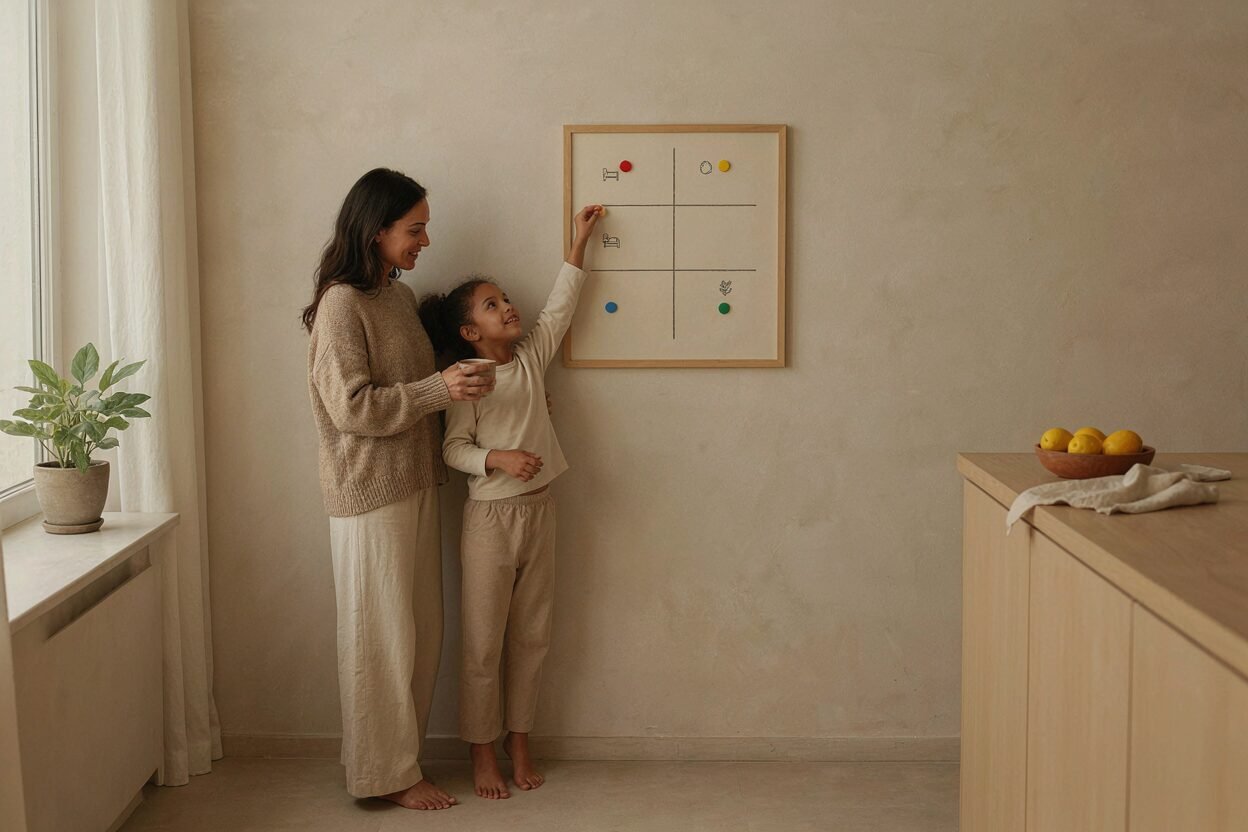
A chore chart for kids is meant to take exactly that weight off your voice and put it on the wall. It shows, in a way your child can understand alone, what their responsibilities are and when to do them. It works best when it has few chores, described in concrete terms, with pictures for kids who can’t read yet, and when it’s made together with your child instead of handed over ready-made like a list of orders.
What a chore chart for kids is for
Young children usually want to help, but they can’t yet keep a sequence of things to do in their heads. The American Academy of Pediatrics (AAP) says most preschool-age children can begin helping with simple household chores and recommends using charts or checklists as a visual reminder of what’s expected. In other words, the chart isn’t bedroom decor: it plays the role of the memory your child is still building.
And that building happens through practice. The Center on the Developing Child at Harvard University explains that we aren’t born with organization and self-control skills, but with the potential to develop them through interactions and practice. When your child looks at the chart, remembers what’s left, does it and checks it off, they’re training exactly that, one day at a time.
Chore chart, routine chart or reward chart: which one to make
| Type of chart | What it shows | When to use it |
|---|---|---|
| Chore chart | Your child’s responsibilities at home (making the bed, setting the table, putting toys away) | When the goal is to share housework and build independence |
| Routine chart | The sequence of the day (wake up, breakfast, school, bath, bed) | For young children who get lost in the day’s transitions |
| Reward chart | Points or stickers that add up to a prize | As a temporary boost for one specific behavior |
In practice, for most families, I’d make a chore chart with a bit of routine built in, split into morning and evening. That way it tackles the two things that most often jam up the house: the rush before school and the mess at the end of the day. A reward system can come later, as a finishing touch, and I explain below why I wouldn’t start with it.
How to make a chore chart for kids in 6 steps
1. Start with just a few chores
The AAP itself suggests introducing one new chore at a time, because long lists can feel overwhelming. Start with two or three that are already part of the day, like brushing teeth and putting pajamas away, and add the rest once those are running on their own.
At our house, the first two chores were making the bed and brushing hair, two things that had always been a battle. So look at your own reality and pick two things that, if they got done, would make the morning (or even the evening) go more smoothly.
2. Describe each chore in concrete terms
“Clean your room” is too vague even for an adult. Pediatrician Laura O’Connor, from Cleveland Clinic, advises swapping general instructions for clearly defined actions. So instead of “clean your room,” write “put the toys in the bin,” “make the bed” and “put dirty clothes in the hamper.” When your child knows exactly what “done” looks like, it’s easier for them to finish and easier for you to praise.
3. Use pictures for kids who can’t read yet
For young children, each chore gets a drawing or a photo of them doing it, and that makes the chart truly theirs, because they can check it without anyone’s help.
The photo shoot can be a really fun game. Your child will love posing while acting out each chore. Printing the photos on plain paper, at any copy shop and without worrying too much about looks, makes everything easier.
4. Choose a format you can mark every day
The best material is whatever holds up to daily use. A printed sheet inside a plastic sleeve lets you check things off with a dry-erase marker and wipe it clean the next day. Magnets on the fridge door work well for kids who like moving pieces around, and a small whiteboard does the job for older kids. Printable templates save time, but you can make one at home with paper, a ruler and markers without spending anything.
5. Make it together with your child
This step often changes the outcome quite a bit. When your child picks the color, draws the icons or decides which chore comes first, the chart stops being an imposed rule and becomes an agreement. The AAP also suggests getting the family together to talk about chores and listen to your kids’ ideas, so use that moment to explain why everyone helps at home.
6. Hang it at their eye level
A chart at adult height, or tucked away in the bedroom, won’t help. Put it somewhere your child passes by, sees and can reach, like the fridge door, a bedroom wall or the hallway outside the bathroom.

What chores to put on the chart, by age
The table below combines suggestions from the AAP and Cleveland Clinic. It’s a reference, but every child has their own pace, so watch your child before following the ages to the letter.
| Age | Chores that usually fit |
|---|---|
| Up to 3 | Putting toys away after playing, putting worn clothes in the hamper, helping set the table |
| 3 to 5 | Making the bed their own way, watering plants or feeding the pet with supervision, cleaning up small spills, carrying light grocery bags, taking their plate to the sink after meals |
| 6 to 10 | Setting and clearing the table, sorting laundry, helping pack the lunch box, sweeping, tidying their room and school things |
| 11 and up | Changing the bed sheets, washing and folding clothes, cleaning the bathroom, making a simple meal with supervision, washing the dishes from a small meal |
For a 6-year-old’s chart, for example, I’d combine two personal morning chores (making the bed and brushing teeth), one household chore (setting the table for dinner) and one evening chore (putting on pajamas alone). If evenings at your house are always hectic, it’s also worth looking at the sleep hygiene habits for the whole family, because several chores on the chart fit into that bedtime ritual.

How to use the chart without it turning into nagging
The first thing to watch is praise. The AAP recommends praising your child’s effort on each chore, not just the result. So a slightly crooked bed made by a 4-year-old deserves a “you did it all by yourself!”, not a redo in front of them. If you fix everything, they quickly learn there’s no point trying.
Then comes the reward, which is where many families get tangled up. Stickers and small prizes work well with young children, according to Cleveland Clinic, but have little effect on preteens. That’s why I wouldn’t start with the prize: I’d start with the agreement and the praise, and use stickers as an occasional celebration, tied to a completed chart for the week.
Finally, timing. A chore without a set time gets put off, and later never comes. Attach each chore to a fixed moment of the day, like “after breakfast,” “when you get home from school” or “after bath time.” Over time, the moment itself becomes the reminder, and the chart is just the confirmation.
A chore chart with more than one child
When there are two or three kids at home, the question stops being “what does each one do” and becomes “why does he do less than me.” The simplest solution is a single chart with one column per child, so everyone can see who does what and nobody needs to complain to you.
For the household chores nobody wants, like taking out the trash or setting the table, a weekly rotation works well, swapping the names every Monday. Personal chores, like brushing teeth and putting away their own school things, stay fixed for each child, adjusted to their age. That way the oldest doesn’t carry the house alone, and the youngest isn’t just watching.
It also helps to have one or two shared chores, like a ten-minute living room tidy-up before dinner where everyone pitches in together. I wrote more about this kind of family tidying in the post on keeping a house organized and clean with kids, with a 30-minute daily routine.

How to keep the chart working after the first week
In the first week the chart is the talk of the house, in the second someone forgets to check it off, and by the end of the month it’s decoration. That happens because it was made once and never revisited, so it stops matching real life.
What keeps the chart going is a short, regular conversation once a week. The AAP suggests regular family meetings to review progress and hear your child’s ideas, and it doesn’t need to be formal: on Sunday, over breakfast, you look at the chart together and decide what stays, what goes and what’s new. When a chore has become a habit and your child does it without looking, it can come off the chart, which makes room for a new one and shows your child they’ve grown.
If the chart has become a reason for tears, fights or fear of getting it wrong, cut back on chores and go back to the original agreement. And if you’re the one who forgets to check, hang the chart near the coffee maker, because the habit has to exist on both sides. Your part is recognizing your kids’ effort: don’t skip that.
Still have questions?
At what age can kids use a chore chart?
As soon as your child is already helping with small chores, which usually happens in the preschool years. For the littlest ones, the chart has only pictures and two or three chores, and an adult does them alongside at first.
What if my child refuses to do a chore?
First check that the chore is clear and right for their age. If it is, the AAP talks about consequences agreed on in advance, like losing a privilege such as screen time, instead of scolding in the moment. Sometimes your child is much more interested in what they’re doing and doesn’t want to stop to do the chore. In that case, set a deadline. For example: they want to keep playing instead of setting the table. Let them know dinner is almost ready and that, if the table isn’t set in 5 minutes, they’ll be in charge of loading the dishwasher with one of the parents, or another chore they find more boring. Just don’t let a refusal end with no consequence at all.
Should kids get paid for chores?
There’s no single rule. For Cleveland Clinic, an allowance is optional and makes more sense once your child understands the value of money. A common approach is to separate the chores everyone does because they live in the house from extra chores, which can earn some money.
To wrap up
A chore chart for kids works when it has a few concrete chores, pictures for kids who can’t read yet and is made together with your child. Day to day, praise the effort, tie each chore to a set time and review the chart once a week so it keeps making sense.
This content is informational and does not replace advice from your pediatrician or another professional who works with your family. If your child has specific developmental needs, talk to their care team before setting chores.