

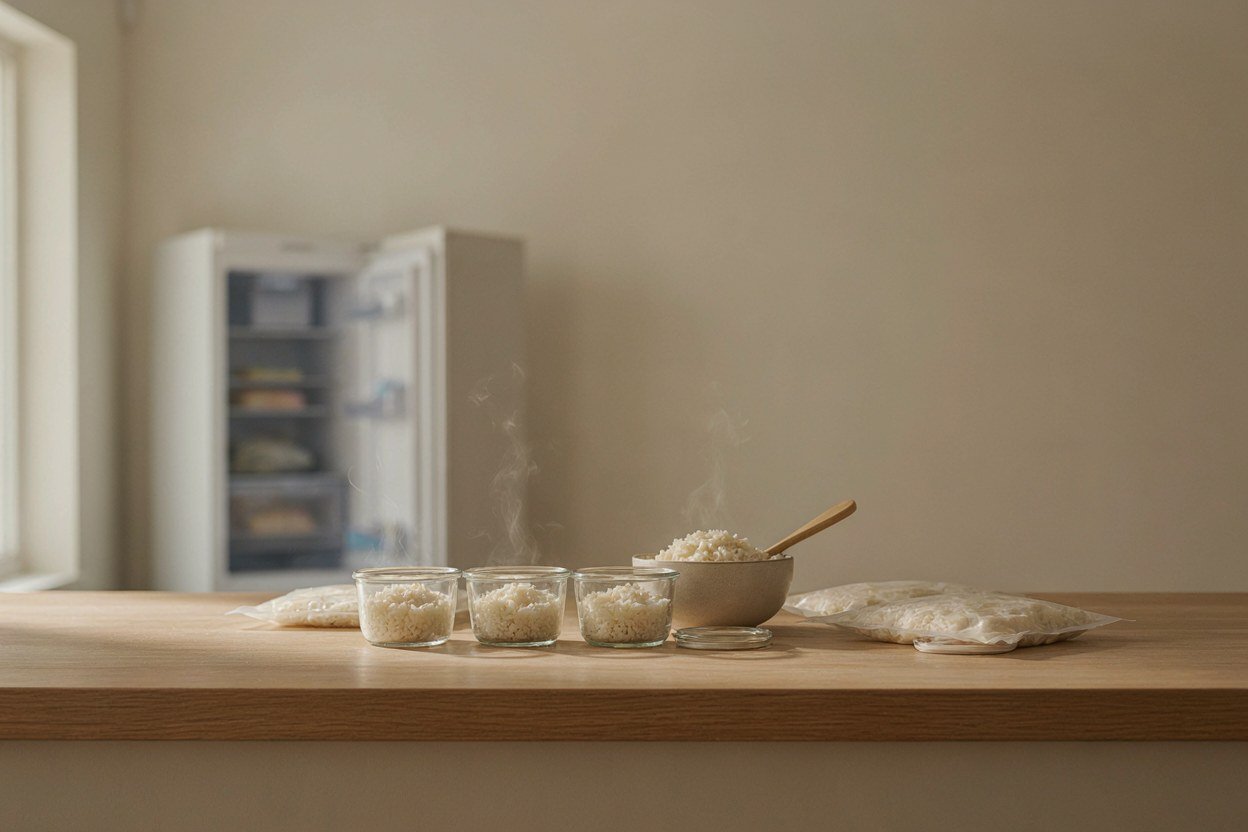
This has probably happened at your house: a big Sunday lunch, you made plenty of rice because you had guests over, but at the end of all that feasting there was a lot left. Then comes the question many people have and almost nobody asks out loud: can you freeze cooked rice, or does it come back hard, bland and even unsafe?
Yes, you can. Cooked rice freezes very well, as long as it cools quickly, goes into the freezer in tightly sealed portions and is reheated until it’s hot all the way through. The real precaution isn’t about the freezer: it’s about the hours rice spends forgotten in the pot, outside the fridge.
Can you freeze cooked rice? Where the real risk is
Many people are wary of leftover rice, and that wariness has a basis, but it usually points at the wrong place. Rice can carry spores of a bacterium called Bacillus cereus, and a report from the São Paulo State Epidemiological Surveillance Center (in Portuguese), in Brazil, explains that these spores survive boiling. In other words, cooking doesn’t eliminate the problem: if cooked rice sits for hours at room temperature, the spores germinate, the bacteria multiply and produce toxins.
The same document notes that outbreaks dominated by vomiting are usually linked precisely to cooked rice left out of the fridge, with symptoms appearing 30 minutes to 6 hours after eating. That’s why its advice is very simple: leftovers go into the fridge right away, and reheating needs to be quick and heat the food all the way through.
Notice that none of this speaks badly of the freezer. The good practices booklet from Anvisa (in Portuguese), Brazil’s health regulatory agency, explains that harmful microbes multiply between 5 °C and 60 °C (41 °F and 140 °F), the so-called danger zone, and the freezer keeps rice well below that range. So freezing cooked rice is safe and even helps, because it gets leftovers out of the bacteria’s way. What ruins the plan is rice sitting all afternoon in the pot on the stove before it goes into a container.

How to freeze cooked rice, step by step
Every stage exists so the rice spends as little time as possible lukewarm:
- Cool it quickly. Spread the rice on a shallow dish or baking sheet in a thin layer, instead of leaving the whole mass in the pot. A thin layer loses heat much faster, and the steam that escapes takes with it the moisture that would later turn into ice. The UK’s Food Standards Agency says to chill rice as quickly as possible, ideally within an hour, and to freeze it within an hour of cooking so the bacteria can’t multiply and produce a toxin.
- Don’t leave it out of the fridge for more than two hours. That’s the limit U.S. health authorities use for leftovers, according to a report in the Brazilian newspaper O Globo (in Portuguese), and it drops to one hour on very hot days. If the rice is still a little warm by then, it can go into the fridge anyway and move to the freezer later. The U.S. Department of Agriculture says the same: throw away perishable food left out for more than 2 hours, or more than 1 hour if it’s above 90 °F (32 °C).
- Divide it into portions the size of one meal for your household. Planning portions ahead saves you from thawing a whole container to use only half.
- Choose the packaging. A container with a tight-sealing lid or a freezer bag with as much air removed as possible both work. In a bag, lay the rice flat, because that way it freezes faster, stacks better and thaws evenly.
- Label it. Anvisa’s booklet asks that all prepared food stored in the fridge or freezer have a name, the date it was made and a use-by date, and masking tape with a pen does the job.
One tip that changes the texture: rice headed for the freezer can come out of the pot a little firmer than usual. It will still get heat and moisture when it’s reheated, and that extra margin is what keeps it from turning mushy the second time around.
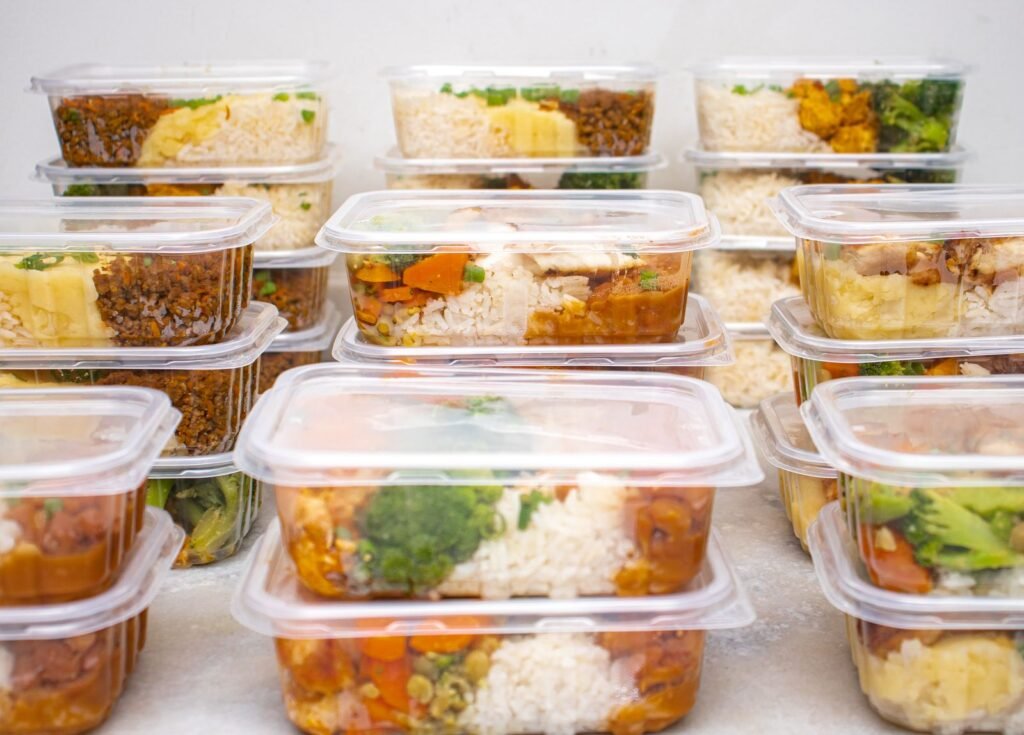
How long cooked rice lasts in the freezer and the fridge
The sources vary a little here, so it’s worth knowing where each number comes from before you decide on yours:
| Where the rice is stored | Time limit | Source |
|---|---|---|
| Fridge (5 °C / 41 °F or below) | Up to 5 days | Anvisa’s good practices booklet, for prepared foods |
| Freezer (quality) | Up to 3 months | Panelinha, for homemade food |
| Freezer (safety limit) | Up to 6 months | U.S. health authorities, cited by O Globo, which suggest under 2 months to keep it fresh |
A note on the fridge row: for rice specifically, the UK’s Food Standards Agency says to eat it within a day of chilling, while the USDA gives 3 to 4 days for leftovers in general. In practice, I’d use the 3 months from the Brazilian cooking site Panelinha (in Portuguese) as the ceiling and try to eat it well before then. The rice doesn’t become dangerous in the fourth month, but it gets drier and picks up a freezer taste, and then the time you saved turns into waste. The USDA adds that frozen leftovers stay safe indefinitely, but can lose moisture and flavor over time, so the 3 months is about quality.
How to reheat frozen rice without drying it out
Rice hardens in the freezer because it loses water, so the secret of any method is to give back a little moisture and heat it evenly.
In the microwave, straight from the freezer
It’s the fastest way and, for rice, it works very well. Put the portion on a microwave-safe plate or bowl, sprinkle a little water on top and cover it with a microwave lid or an upside-down plate to hold in the steam. Then heat it in short bursts, stirring in between, because the block in the middle is usually the last to heat up. The rice is ready when steam comes from the middle of the portion, not just the edges.
On the stovetop, with a splash of water
If you prefer the stove, put the still-frozen rice in a pan with a little water (the Brazilian recipe site TudoGostoso (in Portuguese) suggests ice-cold water) to bring back the moisture, cover it and leave it on low heat, stirring now and then. In a few minutes the steam loosens the clumps and the rice looks freshly made.
Straight into soup or broth
In this case you don’t even need to reheat it separately, since frozen rice can go straight into a soup, a pot of beans or a stew that’s already simmering, as one of the experts interviewed by O Globo suggests.
And if you’d rather thaw it first, do it in the fridge, never on the counter. Anvisa’s booklet is clear: no thawing at room temperature, only in the fridge or the microwave when the food will be cooked right away. Whichever way you go, reheat only the portion that will be eaten, because Panelinha reminds us that thawed food shouldn’t go back into the freezer, although the USDA says food thawed in the fridge can be refrozen.
Which kinds of rice freeze well (and which are best avoided)
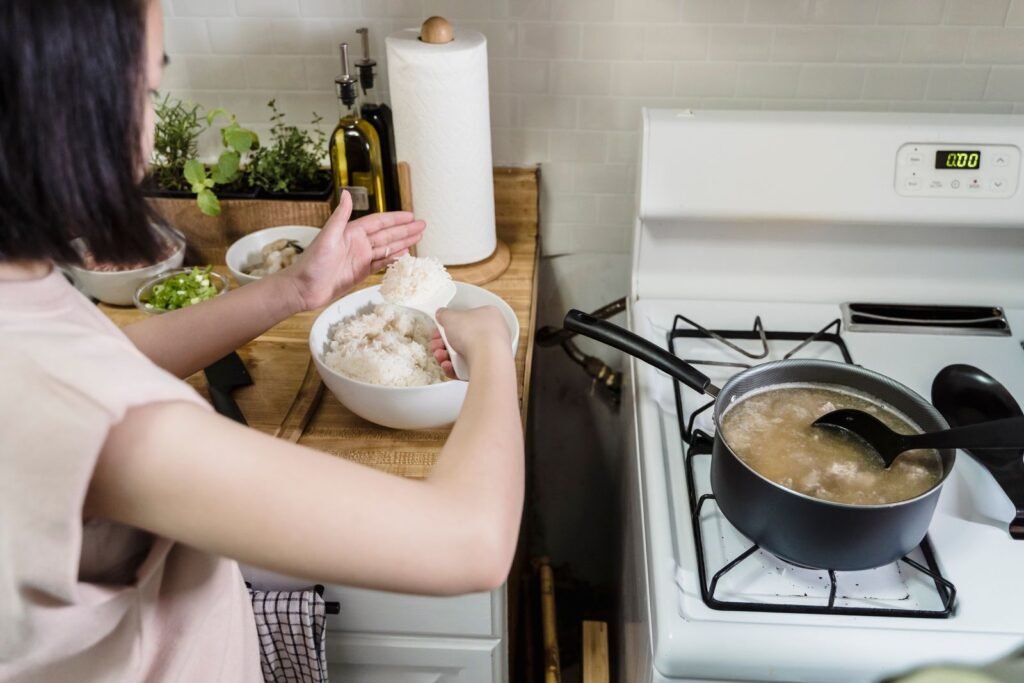
White rice, brown rice, parboiled rice, and rice cooked with carrots, broccoli or mixed vegetables follow the same precautions and freeze in practically the same way. What changes is the texture: the wetter the rice is when it comes out of the pot, the more it tends to go mushy when reheated, which is why the tip about slightly firmer rice is worth following.
Creamy rice dishes with lots of sauce are another story. TudoGostoso advises against freezing creamy, cheesy rice dishes and baked rice casseroles, because in the freezer the grains absorb the liquid from the sauce and the texture turns strange afterwards. So if you want these on hand, freeze plain rice and put the creamy dish together when you serve it.
And the classic question for anyone who packs lunches: can you freeze rice and beans together? You can, but keeping them separate gives you more control, because you can heat each one the way it needs. Beans, in fact, can go into the freezer unseasoned, just in their cooking liquid, so you can add a fresh sauté when you serve them, which is Panelinha’s tip. For ready-made packed meals, putting them in the same container works fine, as long as they’re eaten within the time limit.
How to fit frozen rice into your family routine
The simplest way is to stop cooking rice every day and make a bigger pot once or twice a week instead. On big-pot day, while the rice cooks, set out the dish for cooling and the labeled containers on the counter, which is the logic of mise en place in a home kitchen applied to the whole week.
Think about the math for a family with kids: rice shows up at lunch and dinner, and every time it’s a pot on the stove, a pot in the sink and someone keeping an eye on it so it doesn’t burn. With portions in the freezer, rice stops being a step and becomes just one more thing to heat while you cook the meat or the eggs, which fits very well with a cheap weekly meal plan put together on the weekend.
With young children at home, one more precaution is worth taking. The experts interviewed by O Globo point out that children under 5, pregnant women and people over 65 are more vulnerable to food poisoning, so for them I’d follow the two rules that matter most to the letter: rice into the fridge as soon as it cools, and reheated until piping hot all the way through.
How to keep the freezer organized so the rice doesn’t get lost
Over time, the problem shifts: the rice isn’t unsafe, it just gets forgotten at the back of the freezer, under the bag of frozen peas. To keep that from happening, always keep the rice containers in the same corner and put the newest ones at the back, so you use what was frozen first.
It also helps not to fill the freezer with warm food all at once, because that warms up what was already frozen around it. And if the rice comes out with a thick crust of ice and a freezer smell, it has lost quality, so it’s better stirred into a soup than served as a side. If your freezer also holds the week’s meat, the same plan-ahead logic applies, as I explain in the guide on how to thaw meat the right way.
Still have questions?
Is frozen rice bad for your health?
No. Freezing doesn’t create any new risk for rice. What can make you sick is the time it spends at room temperature before it’s put away.
Can I freeze rice that sat out overnight?
It’s not a good idea. The freezer only pauses what has already happened, and the toxins the bacteria produce during that time aren’t destroyed even by thorough reheating, as the researcher interviewed by O Globo explains. Rice forgotten outside the fridge for many hours goes in the trash.
How many times can I reheat the same rice?
Ideally just once. According to the O Globo report, some experts recommend reheating it no more than once, because every trip out of the fridge means more time in the danger zone.
To wrap up
Yes, you can freeze cooked rice: cool it quickly in a thin layer, store it in labeled portions and use it within 3 months. When it’s time to eat, reheat it with a little water until steam comes from the middle, and never leave cooked rice out of the fridge for hours.
This content is informational and does not replace advice from a dietitian or other health professional.