
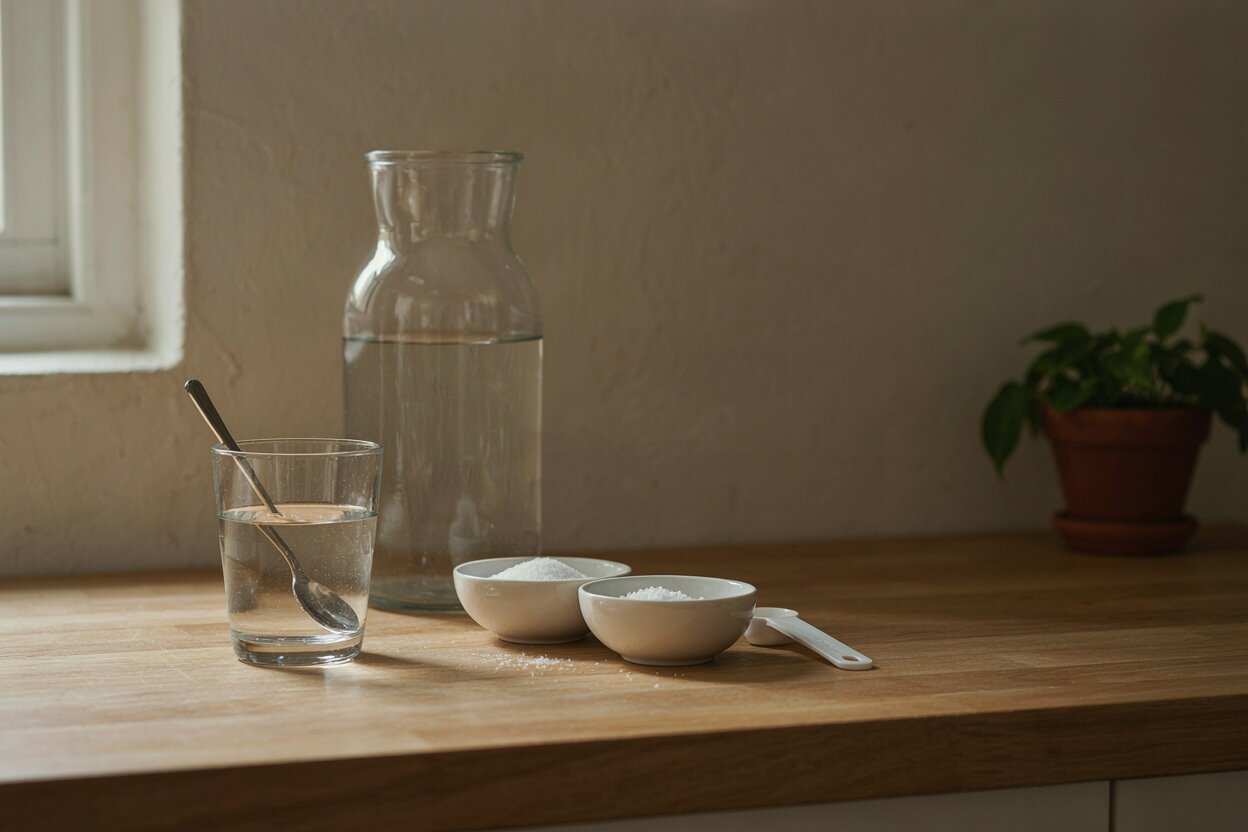
Picture this: it is eleven at night, your child is sick, has already been to the bathroom four times, is lying limp on the couch, and you open the cabinet looking for a packet of oral rehydration salts that, of course, ran out after the last stomach bug. Then the usual doubt hits: how much salt and how much sugar go into a homemade oral rehydration solution? Everybody remembers the recipe roughly, and nobody remembers it exactly.
The Brazilian Ministry of Health recipe uses 1 full glass of clean water (200 ml), 1 level measure of salt and 2 level measures of sugar, taken with the Brazilian measuring spoon. Without that spoon, the UFMG School of Medicine says to mix 1 coffee spoon of salt (a small spoon, about ½ teaspoon) and 1 tablespoon of sugar into 1 liter of filtered water. Below you will find the step by step, how much to give and the signs that it is time to get medical care.
Reading from outside Brazil? This guide follows Brazilian health authorities, and other organizations publish home recipes with different measures, so if your doctor or local health service gave you another recipe, follow theirs. The WHO fact sheet on diarrhoeal disease describes oral rehydration solution as a mix of clean water, sugar and salt and advises continuing to give food, including breast milk, and the NHS guide to diarrhoea and vomiting says a pharmacist can recommend oral rehydration powder to mix with water.
What it is for (and what it does not do)
When someone has diarrhea or vomits several times, the body loses water and also mineral salts, and that double loss is what leads to dehydration. The solution replaces both at the same time, which plain water alone does not do. The Alagoas State Health Department sums it up well: it does not treat vomiting or diarrhea (in Portuguese), it only replaces what was lost while the body recovers.
And getting the measures wrong is more common than it seems. A study cited in the Jornal de Pediatria (in Portuguese) analyzed solutions prepared by community health agents in Ouro Preto, in the Brazilian state of Minas Gerais, and found improper preparation in 71.1% to 96.1% of the samples, depending on the method used. If even the people who teach families get it wrong, imagine the rest of us in a middle-of-the-night panic. That is why the recipe below comes with exact measures and a simple check.
How to make oral rehydration solution at home, step by step
With the measuring spoon (the safest way)
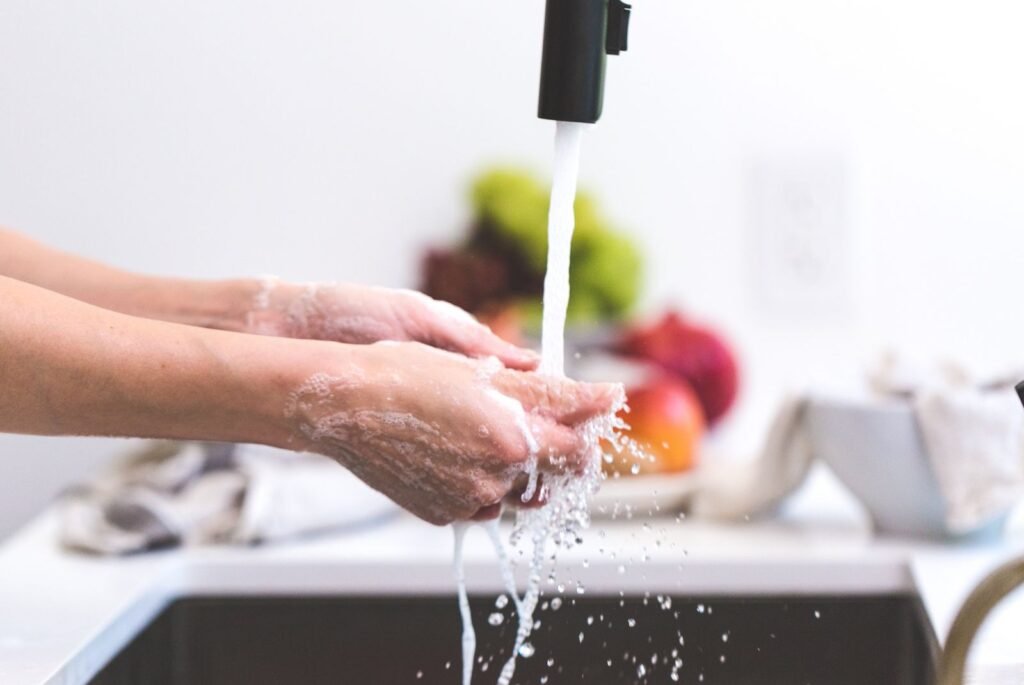
- Wash your hands well and set out a 200 ml glass.
- Fill the glass with clean water: filtered, boiled (and cooled) or bottled.
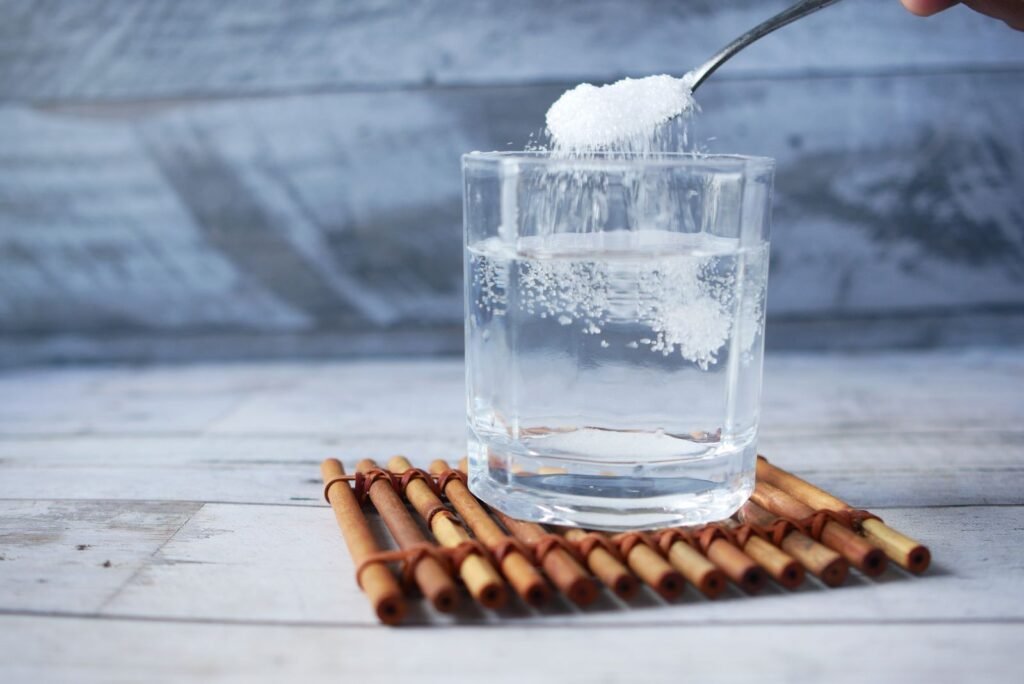
- Add 1 level measure of salt, using the small end of the spoon.
- Add 2 level measures of sugar, now with the large end.
- Stir until dissolved and taste before giving it.
This is the recipe from the Ministry of Health leaflet (in Portuguese) and also the one the Pastoral da Criança, a Brazilian child health organization, teaches families. The spoon already holds the right amount, so one person’s “heaping spoon” cannot become another’s “level spoon”. In Brazil, you can ask for one at your neighborhood Basic Health Unit (UBS).
Without the measuring spoon: the 1 liter version
If you do not have the spoon, the pediatrics page of the UFMG School of Medicine (in Portuguese) recommends making 1 liter: 1 liter of filtered water, 1 coffee spoon of salt and 1 tablespoon of sugar. Making the whole pitcher helps, because a small error with the spoon weighs less in 1 liter than in a glass.
What if you only want one 200 ml glass with regular spoons? In the official sources I checked, there is no kitchen-spoon measure for a single glass, so the safest option is to make the liter and serve it by the glass through the day. One more catch: a coffee spoon is smaller than a teaspoon, and swapping one for the other puts too much salt in the solution.
| Version | Water | Salt | Sugar | Source |
|---|---|---|---|---|
| With the measuring spoon | 1 full glass (200 ml) | 1 level measure (small end) | 2 level measures (large end) | Brazilian Ministry of Health |
| With kitchen spoons | 1 liter, filtered | 1 coffee spoon (about ½ teaspoon) | 1 tablespoon | UFMG School of Medicine |
The tear test and the right water
After mixing, taste a small sip. The Ministry of Health says the solution should be less salty than a tear. If it came out too salty, throw it out and start over instead of trying to fix it by eye.
Use filtered, boiled and cooled, or bottled water, because someone with diarrhea does not need another reason for their gut to complain. If you are traveling, see whether you can drink tap water in Brazil.
How much to give and how to give it
The Ministry of Health poster on managing diarrhea (in Portuguese) gives a reference by age for the liquid offered after each diarrheal stool:
| Age | How much to offer after each stool |
|---|---|
| Under 1 year | 50 to 100 ml |
| 1 to 10 years | 100 to 200 ml |
| Over 10 years | As much as the person will take |
The Alagoas State Health Department advises small sips, no more than half a glass at a time, and young children take it better from a spoon. If they vomit, the Ministry of Health says to wait 10 minutes and offer a small amount again.
Food stays on the menu: the Ministry of Health advises keeping the usual diet and, for babies, not stopping breastfeeding. If your child refuses the plate, offer a little at a time. Soda does not hydrate someone with diarrhea, and any tea or juice during this time should have no sugar.
Homemade or pharmacy packet: which one to choose?
With both options at hand, I would choose the packet of oral rehydration salts, because it comes with the exact dose and removes the measuring error. The Jornal de Pediatria article notes that the World Health Organization considers the home-made solution potentially effective but does not recommend it as a first choice, precisely because of preparation errors.
The packet has its own rule: according to UFMG and the Ministry of Health, the whole packet goes into 1 liter of water, with no added salt or sugar and no boiling once it is ready. The home recipe is for when the packets ran out and the pharmacy is closed.
Get a small kit ready before you need it
Diarrhea and vomiting always show up at the worst time. Next to the household medicines, somewhere every adult knows, I would keep:
- two or three packets of oral rehydration salts, checking the expiry date now and then;
- the measuring spoon in a small bag, so it does not vanish among the cutlery;
- the recipe written on a note taped inside the cabinet door, because at eleven at night nobody wants to search on a phone;
- a bottle or pitcher just for the solution, which has to be made fresh every day. And since stomach bugs spread easily, clean hands and a clean house with kids are part of the deal.
An extra caution for some adults: the solution contains salt and sugar, so the Alagoas State Health Department advises people with diabetes not to take the home-made version and to seek medical advice. People with high blood pressure, kidney or heart disease should also ask their doctor about the best way to rehydrate. Until then, keep offering plain water in small sips.
Warning signs: when it is not enough
The solution handles mild dehydration at home, but it has limits. According to the Ministry of Health material, the person should be taken to a health service if any of these signs appear:
- the diarrhea gets worse or the vomiting keeps coming back;
- very intense thirst, with the child drinking fast and eagerly;
- blood in the stool or high fever;
- sunken eyes, crying without tears or unusual irritability;
- excessive sleepiness, a limp child or one who cannot drink, which are signs of severe dehydration.
The Alagoas State Health Department also advises seeing a doctor when diarrhea and vomiting last more than 24 hours. And do not give medicine to “stop” the bowels on your own, because it can make a child’s condition worse. Never medicate without medical advice.
Still have questions?
Can I give homemade oral rehydration solution to a baby?
With babies, the margin is smaller. For babies under 6 months, or if you have any doubt about the amount, talk to the pediatrician before offering anything other than breast milk. From there, the Ministry of Health reference for children under 1 year is 50 to 100 ml after each stool, without stopping breastfeeding.
How long does it last once prepared?
24 hours at most. After that, pour out what is left and make a fresh batch, as the Ministry of Health, UFMG and the Pastoral da Criança advise.
Can I add more sugar or juice so my child accepts it?
No. Changing the proportions changes the solution and can get in the way of rehydration. If your child refuses, offer smaller amounts, by the spoon, more often.
Can it be used as a nasal rinse?
No. It contains sugar and is made for drinking. A nasal rinse is a different product, and the pediatrician or doctor should explain how to use it.
To wrap up
The right homemade oral rehydration solution is 1 glass of clean water with 1 level measure of salt and 2 of sugar, or 1 liter with 1 coffee spoon of salt and 1 tablespoon of sugar, always tasted first. Give it in sips after each stool, choose the pharmacy packet when you have it and seek care at any warning sign.
This content is for information only and is based on materials from the Brazilian Ministry of Health, state health departments and medical institutions. It does not replace an evaluation by a doctor or pediatrician, especially for babies, older adults and people with chronic conditions.