

You’re heading home at the end of the day, already thinking about everything you need to do when you walk in the door. Suddenly a painful memory hits you and makes your heart sink: you forgot to thaw the meat, and you’re already trying to figure out how to fix it. Anyone who cooks for a family knows that feeling, and that’s when the question comes up of how to thaw meat without making it rubbery and, above all, without risking food poisoning.
The safest way to thaw meat is in the fridge, overnight. If you forgot, you can use cold water with the meat in a tightly sealed bag, or the microwave, as long as it goes into the pan right afterwards. What you can’t do is leave the meat on the counter, in the sink or in hot water.
Why the way you thaw meat changes safety and texture
The freezer doesn’t kill the bacteria in meat: it just puts them on pause. When the meat starts to warm up, they get back to work, and the good practices booklet from Anvisa (in Portuguese), Brazil’s health regulatory agency, explains that harmful microbes multiply between 5 °C and 60 °C (41 °F and 140 °F), a range it calls the danger zone. That’s why the same booklet says never to thaw food at room temperature.
The problem with the counter is that meat doesn’t thaw evenly. The center stays hard, but the outside passed 5 °C (41 °F) a good while ago, and it’s precisely on the surface that bacteria find the warmth they need to multiply. So that piece that looks “still frozen” may have its whole outer layer inside the danger zone.
Then there’s the part you notice on the plate. When meat thaws too fast or unevenly, it tends to release more liquid, and some of the juiciness goes with it. In practice, a slow, cold thaw usually leaves a steak more tender than a rushed one, and that’s why the fridge always comes first.
How to thaw meat in the fridge, step by step
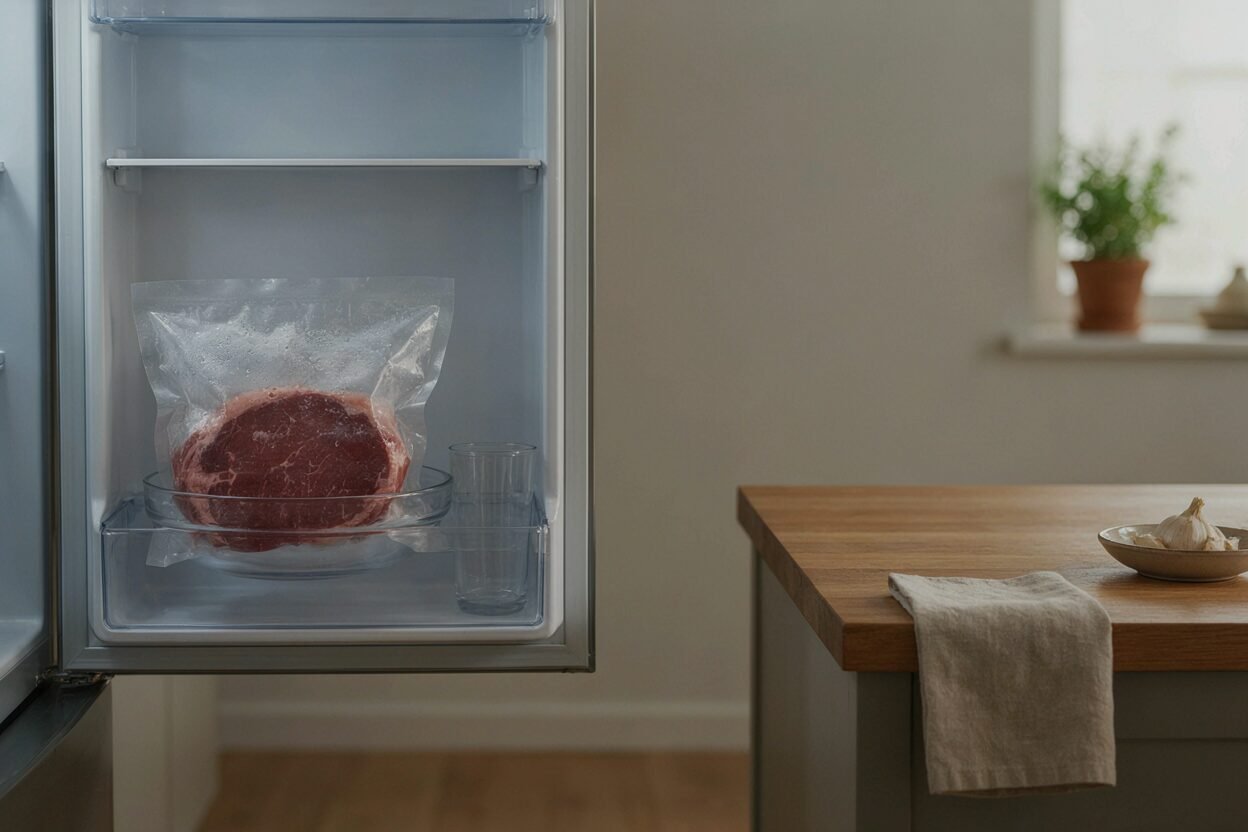
This is the method that Anvisa’s food service regulation (RDC 216/2004) (in Portuguese) sets as the rule, with food refrigerated below 5 °C (41 °F). At home, it just takes a little planning:
- Take the meat out of the freezer and leave it in the package it was frozen in, unopened.
- Put the package in a deep plate or a container, because the meat releases liquid, and that liquid can’t drip onto other foods.
- Store it on the bottom shelf or in the meat drawer, which are usually the coldest parts of the fridge and sit below foods that are ready to eat.
- Give it the time it needs. According to the U.S. Department of Agriculture’s Food Safety and Inspection Service (FSIS/USDA), even a pound of ground meat or a few steaks need a full day, and large cuts take about 24 hours for every 2 to 2.5 kg (4 to 5 lb).
- When you’re ready to cook, discard the liquid in the plate and wash the container well.
Timing varies a lot from fridge to fridge. The FSIS/USDA points out that a colder fridge takes longer to thaw food and that some shelves are colder than others. So if your steak is still hard in the center at lunchtime, it’s not your fault: it’s just the fridge doing its job.
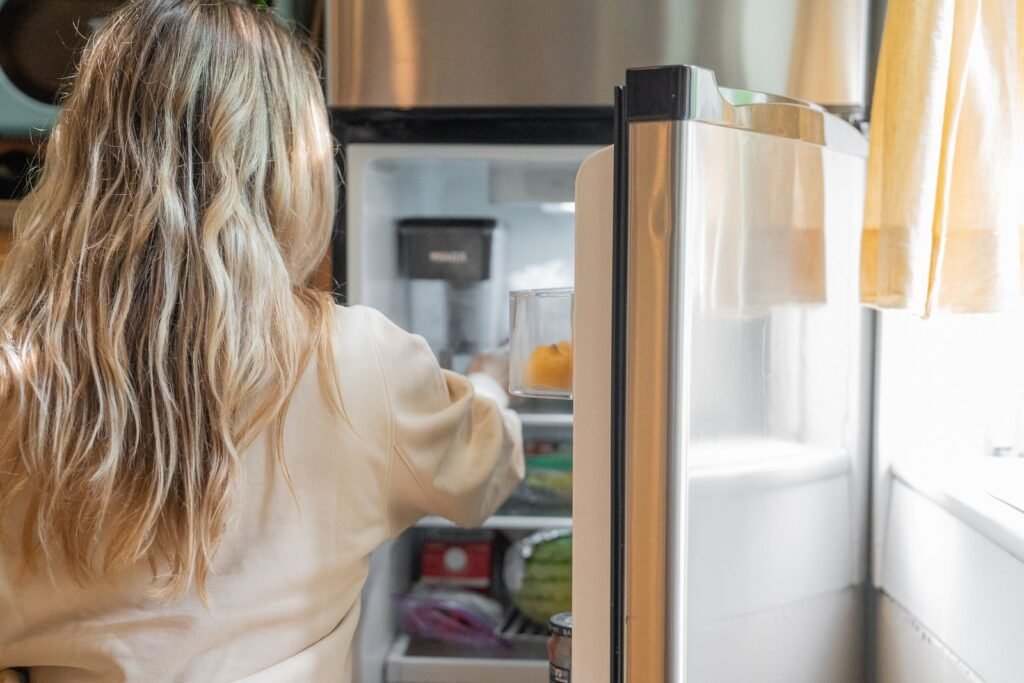
Forgot to take it out of the freezer? Two quick, safe ways
For those days, the FSIS/USDA accepts two more methods, both with the same condition: the meat must be cooked as soon as it finishes thawing.
In cold water, with the meat tightly sealed
Put the meat in a leak-proof plastic bag, squeeze out the air and submerge it in a bowl of cold tap water. The bag has to be well sealed, because if water gets in, the meat gets waterlogged and can be contaminated by whatever is in the sink. Change the water every 30 minutes, since it warms up over time and stops doing its job.
By the FSIS/USDA’s numbers, a package of about 1 lb (roughly half a kilo) thaws in an hour or less, and a 3 to 4 lb (1.5 to 2 kg) package takes 2 to 3 hours. Notice that this makes cold water a good option for lunch, when you remember the meat early in the morning, but not so much if you remembered ten minutes before dinner.
In the microwave, to cook right away
The microwave is the emergency rescue, and it appears in both Anvisa’s regulation and the FSIS/USDA guidance, always with the caveat that the food goes straight to cooking. That’s because some parts of the meat start to cook while others are still frozen, and that warm part can’t sit around waiting.
Use your microwave’s defrost setting, if it has one, or follow the power level in the manual. Put the meat in a deep microwave-safe dish, without the foam tray, and turn it now and then so it thaws evenly. Some models already include this pause as part of the defrost program. When the edges start to change color, stop, because that part is already cooking.
No time at all? Cook the meat from frozen
Few people know this, but cooking meat from frozen is safe, according to the FSIS/USDA. It takes about 50% longer than usual, so it works best with thin cuts, ground meat and stew cubes, which heat evenly. A large, thick cut, on the other hand, risks being overcooked outside and raw in the middle, and in that case I’d rather change the day’s menu.
Here on the blog there are seven quick and easy dinner ideas to help on those extra-tight days. Leave the meat for tomorrow’s dinner and make one of those recipes with ingredients you probably have in your pantry.
What not to do: the counter, hot water and internet hacks
Leaving meat on the counter or in the sink “just for a couple of hours” is exactly what Anvisa says to avoid, for the surface reason we saw above.
Hot water is on the same list. The FSIS/USDA states plainly that perishable foods shouldn’t be thawed in hot water or left at room temperature for more than two hours, because the outside warms up long before the center. And that goes for the videos promising to thaw a steak in five minutes with a pot of hot water, vinegar or salt. I didn’t find any guidance from an official agency recommending these hacks, and until there is, I’d rather stick with what Anvisa and the FSIS/USDA say.
Thawing outside the package, straight on an open plate, isn’t a good idea either, because the liquid the meat releases can contaminate other foods, a warning that appears in Anvisa’s booklet itself.
Which method to use in each situation of the week
This table helps you choose at a glance:
| Situation | Method | Main precaution |
|---|---|---|
| You planned tomorrow’s dinner | Fridge | Deep plate underneath and bottom shelf |
| You remembered in the morning, meat for lunch | Cold water | Tightly sealed bag and fresh water every 30 minutes |
| Dinner is minutes away | Microwave | Straight into the pan |
| Ground meat, thin steak or cubes, and no time | Cook from frozen | Medium heat and longer cooking time |
| Large cut for the weekend | Fridge | Start one or two days ahead |
How to remember to thaw meat with a busy routine
The most effective trick to thaw meat the right way isn’t in the kitchen at all: it’s in planning. When the weekly meal plan is already set, taking the meat out of the freezer becomes an item on the list, not a last-minute memory.
A few ideas that fit well into a routine with kids:
- Tie the task to something you already do every night, like packing the lunch box or washing the dinner dishes. Lunch box closed, meat moves from the freezer to the fridge.
- A phone alarm at eight p.m., labeled with the name of the next day’s dish, works for anyone who even forgets the lunch box (so me!).
- Freeze meat in flat portions inside the bag instead of a thick block, because a thin layer thaws much faster and fits in any corner of the freezer.
- Pack one meal’s worth per bag, so you only thaw what you’ll use.
- Write the cut and the freezing date on the bag, as Anvisa’s booklet advises for food stored in the freezer. It seems silly, until the day you don’t know whether it’s top round or chuck and, worse, how many months that meat has been forgotten in there.
Mise en place helps a lot here, because with the onion and garlic already chopped, the meat comes out of the fridge and goes straight into the pan.
For the days when the thawed meat is ground beef, here’s some extra help: I put together 10 ground beef recipes to save dinner, all designed for people short on time.
Still have questions?
Can you refreeze meat that has been thawed?
It depends on how it was thawed. If it was in cold water or the microwave, it can only go back in the freezer after it’s cooked. If it was in the fridge and stayed cold the whole time, the FSIS/USDA allows refreezing it raw, with some loss of quality. Anvisa’s food service regulation, on the other hand, prohibits refreezing, so at home the most prudent option is to thaw only the portion you’re going to use.
How long does thawed meat last in the fridge?
For meat thawed in the fridge, the FSIS/USDA gives 1 to 2 days for ground meat and stew meat, and 3 to 5 days for steaks, chops and whole cuts of beef or pork. If the manufacturer’s label gives a different time, go with the label.
The meat released a red liquid. Has it gone bad?
Not necessarily. All meat releases some liquid when it thaws, and what matters is that it stays contained in the plate and gets thrown away. Be suspicious if there’s a strange smell, a sticky texture or a greenish color, and when in doubt, don’t eat it.
To wrap up
To thaw meat safely without ruining the texture, the fridge is the first choice, with the meat wrapped and in a deep plate on the bottom shelf. Forgot? Cold water or the microwave, then straight into the pan. The counter and hot water, never.
This content is informational and does not replace advice from a dietitian or other health professional.